

A Quiet Insight That Agencies Have Missed
Most agencies already know the biggest problem with podcast pitches. They are too generic. They sound the same. They feel the same. They follow the same pattern. A podcast producer can see them coming from a mile away. You can write well. You can plan well. You can understand podcasting and podcast production. But if the pitch reads like every other pitch, it fades into the blur of a crowded inbox.
But there is a small strategic idea that has not been talked about. It has not been part of the usual tips. It is not about subject lines or story hooks or clever framing. It is not about length or tone or timing. It is something simpler. And it has now been measured for the first time.
BuzzStream has done a study led by Vince Nero that shows the power of the sender identity. It reveals that when you pitch from the client domain and not from the agency domain, people respond more. This does not fix generic writing. This does not replace strong ideas. But it gives the pitch a better chance. It signals trust before a single word of the message is read.
This is not a trick. It is a foundation. It is the kind of insight that changes how agencies think about outreach. It is the kind of insight that helps any podcast production agency make better choices. It is the kind of insight that turns one small detail into a meaningful advantage.
Why The Sender Line Matters Even When The Pitch Is Strong
The client still needs your agency skills.
Some clients try to pitch themselves to save time or money, but these pitches often fall flat. The message becomes vague or too focused on promotion. It doesn’t show the insight or the story a producer needs. Agencies do this work every day and understand what a podcast producer looks for. Agencies write with clarity. They shape a guest into a real asset for the episode. This is why agency crafted pitches usually work better than client written pitches. Vince Nero from BuzzStream has suggested this may be the case because agencies remove noise and create a clean path between the guest and the show. When you combine strong agency writing with the client domain that builds trust, you get the best of both worlds.
But even when your pitch is good, the podcast producer (and I’m one of them) often makes a judgment before reading the first line. They look at the sender. They ask themselves a simple question. Does this message feel like it comes from someone real?
When the email comes from the client domain, it feels like the guest is reaching out. It feels close. It feels like the guest owns their story and is ready to share it. When it comes from the agency domain, the pitch can feel distant. It can feel like a layer sits between the producer and the guest. It can feel like the pitch might not carry lived experience.
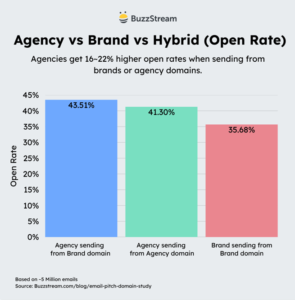
BuzzStream has now proven this reaction with data. It is not a guess. It is not a hunch. It shows that people respond more when the message is published or sent from the domain that belongs to the subject. This applies across content outreach and it applies to podcasting. It gives agencies a real edge. It gives your podcast production workflow a stronger base to build from. And it gives podcast producers a faster way to trust what they see.
This is not a cure-all. A weak pitch is still a weak pitch. But a strong pitch sent from the wrong domain never gets the chance it deserves. That is why this small change matters.
The Proof
This offers clear numbers that show the gap between client domain performance and agency domain performance. It is the first time this point has been studied with real data. And it gives agencies something rare. A measurable advantage.
For anyone in podcasting.
For anyone in podcast production.
For any podcast production agency that sends pitches every day.
This is a new piece of the puzzle.
How Agencies Can Use This Insight Without Losing Their Voice
The first step is not technical. It’s human. Ask your client for access to a simple email identity on their domain. Explain why. Explain the BuzzStream study. Explain that this is one more tool to help their voice rise above the noise. Most clients will understand. Most will welcome the idea.
When you write the pitch from the client domain, do not turn it into marketing language. Keep it simple. Keep it real. Keep it direct. Clean lines. Short sentences. A producer wants to know what the guest can bring to the episode. They don’t want drama. They want truth.
You can still guide the message. You can still shape the story. You can still do the work your agency is known for. But now the pitch feels closer to the speaker. It feels grounded in the world the guest comes from. It feels like a real person reaching out to share knowledge in a podcast setting.
This does not remove the need to avoid generic writing. It does not remove the need to think deeply about ideas. It does not remove the need to show why the guest matters. You still must offer something new. You still must speak with purpose. But now you are sending that purpose from the best possible place.
A podcast producer feels it.
A host feels it.
A show team feels it.
And that feeling gets you further.
Why This One Tip Belongs In Every Agency Workflow
You already know the main problems. Most pitches are too broad. Most pitches lack a strong point of view. Most pitches do not connect the guest story to the audience story. Those problems remain. They always will. You still need to teach your team to write well. You still need to think about how podcasting works. You still need to understand how podcast production shapes the listening experience.
When you pitch from the client domain you give the guest more power. You give their voice a direct path to the producer. You remove friction. You remove doubt. And you make your strong pitches stronger.
Pitch from the place where the story begins.
Pitch from the client domain.
And let trust open the door.