Lady Emily [00:00] In business, the hardest thing to know is whether your name is an asset or an anchor. Sometimes the industry shifts the language and leaves you holding a title that no longer means what you built it to mean. Today's episode is about what you do next.
Doug Downs [00:20] In 2019, Taylor Swift found out she didn't own her music, not the rights so much as the actual music itself. A man named Scooter Braun had bought her masters, six albums, everything she'd written since she was 15. Her team told her to move on, make new music. The old catalog was his now. Well, she didn't move on. She went back to the beginning, same songs, same words, same melodies. She rerecorded every album she still had the rights to, and she released them again one by one. Taylor's version. She didn't reinvent herself. She didn't pivot. She didn't hire a consultant to tell her who she should be now. She just did the work again and put her name back on it because the work didn't change, only the words around it did. Right now, there's an entire industry having that same crisis. For the last 20 years, we've called it SEO.
Doug Downs [01:14] Get you to the top of Google. You know the pitch. Then AI changed how people search and suddenly everyone started calling it GEO, generative engine optimization. And SEO agencies everywhere woke up one morning and realized their name sounded like a rotary phone. The work hadn't changed much, the words had. And some SEO agencies like the one we're talking with today are right in the middle of figuring out what to call themselves next. SEO, GEO. Today on Stories and Strategies, looks like we've got a blank space, baby, and we're about to write a name.
Doug Downs [02:04] My name is Doug Downs. My guest this week is Greg Heilers is joining today from that San Francisco area of California. Hey, Greg.
Greg Heilers [02:12] Doug, thank you so much for making this happen. I'm excited to be here, everyone.
Doug Downs [02:16] Yeah, and you and I have been talking about this episode for months. How are things in San Fran? How's the bridge?
Greg Heilers [02:23] The bridge is still beautiful. We got delayed because I was on the other side of the Pacific, but I'm glad to be back on this side.
Doug Downs [02:30] Awesome. Greg, you cofounded Jolly SEO in 2017. The name has changed. We'll get to that. And since then, you've built one of the most prolific earned link building operations in the industry with your team sending about a quarter million pitches to more than 25,000 wins across hundreds of client campaigns. And right now, after almost a decade of building that reputation under the name Jolly SEO, you've gone through the pain of trying to figure out what to call yourself next. So I got to ask, what is wrong? Given what you do, what is wrong with Jolly SEO? What's the problem? I know what SEO is. SEO is SEO.
Greg Heilers [03:12] Yeah, everyone knows what SEO is. And honestly, when I have doubts, it's a question I still ask myself after having gone through the rebrand, but SEO was signaling to people that we weren't aware of AI search, that we weren't aware that a lot of consumers' behaviors shifted. They no longer use Google, they use ChatGPT, or at least until their free limits run out and then they go back to Google. But we with just SEO, SEO, SEO in our name, we were signaling to the market that we weren't able to serve them in this new era of search. So we had to move on.
Doug Downs [03:46] And technically my understanding is GEO and AEO are actually SEO, but people don't think that way.
Greg Heilers [04:00] Yeah. Well, and it's changing all the time, Doug, because we're recording here in September of 26, and a year ago I would've said they're 95% the same. In fact, I got that SEO in 2026 book over my shoulder. My quote in there is, "Don't throw the baby out with the bath water." But they've been diverging and I think our team puts it at something like 65% overlap right now.
Doug Downs [04:26] Okay. That's interesting. Okay. I promise, not an episode about SEO. Stay awake. This is a rebranding exercise. All right. Walk me through, because you've completed the rebrand, just completed the rebrand, what did you land on and what did the process look like?
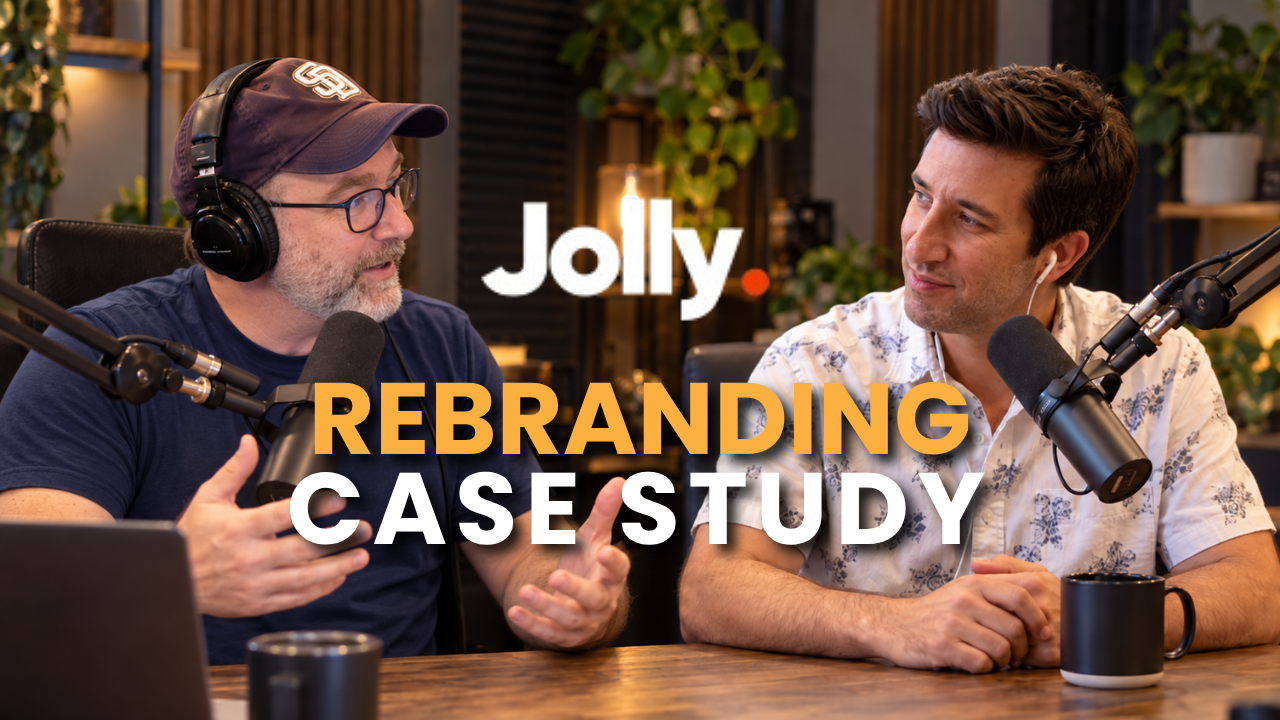
Greg Heilers [04:46] Yeah, so we're Jolly Search obviously now. The process for us was really puzzling through Jolly is a part of our name that's unique in our industry and then signaling what industry are we actually in. And so we pretty early decided, no, we don't need to throw everything out. We're going to stick with Jolly, but we did need to move on from the SEO. And they were kind of equally but differently painful decisions for us to figure out what to do there.
Doug Downs [05:19] Help me through it because when you land on Jolly Search, it just sounds like, given the challenge you had, it just sounds like duh.
Greg Heilers [05:27] Yeah, exactly. Did
Doug Downs [05:29] This take five minutes? And that's proof that it worked. That's when it's painless and seamless and looks simple and feels simple, that's proof he got it right, but walk me through the pain.
Greg Heilers [05:41] Yeah. Well, yes and no. Early on we thought that would be simple, but I could only find searchjolly.com, not Jolly Search. So then we spent a couple months playing with all the different ideas. Our operations director, Muscan, even was like, "Oh, we just go all in on Morgan and Greg." Morgan being my cofounder. And we were both like, "No, no, no. We keep the Jolly. Don't focus on Morgan and Greg." And then Muscan spotted jollysearch.com came up for auction. We bought it for way less than we had been planning to buy it. And as you said, it was like, now that we have this, duh, the conversation's over. We're just sticking with the plan.
Doug Downs [06:22] Okay. The stick with Jolly, that works for people who already have a level of awareness of your brand. It doesn't work, I don't think. I don't think most people using search are jolly by nature. I'm
Greg Heilers [06:39] Smiling.
Doug Downs [06:41] Well, you are. Yes. Yes. But if I'm looking for a company that's going to help me with the kind of links that you are able to build, I'm not necessarily in a jolly mood. I'm in a business. Let me get this. We're falling behind. Let me get this. You'd landed on Jolly early on, obviously with Jolly SEO, and that decision to keep it, it works for those aware of you. It doesn't work for those not aware of you. Talk me through that process because ultimately, does that work in search?
Greg Heilers [07:19] With search itself, a rebrand and then what's on the back end of that is called a 301. It just means sending your old website into your new website. We're going to feel that impact for another six months. Unfortunately, it just is what it is. Anytime we have a client going through this, we're like, oh, here we go. It's going to be hard to recover and it's an uphill battle. But does it work for the humans not aware of us? That's why we had to keep the Search in. We definitely all knew we can't just have Jolly. If you saw on our site, our logo just says Jolly, but we knew we can't just refer to ourselves as Jolly. You're totally right. I had had an episode with someone else who went through a rebrand and it's a cool name, but I did have the same question of what does it mean to the people who don't know you?
Doug Downs [08:13] Do you have to build paid promotion in with this?
Greg Heilers [08:17] Yeah. Aren't they paying you like 10,000? No.
Doug Downs [08:20] The jack hasn't come in. Trust me.
Greg Heilers [08:23] Right. Yeah. No, jokes aside. Yeah, that's funny. So I'm not a professional, Doug. I really enjoyed learning from you when you were on our podcast and I have thought of the same. And so we are doing three or four campaigns. They're not explicitly to say, "Hooray, we're now Jolly Search," but they were with that in my mind of we've got to get this new name out in front of people so that people can see that I'm connected. There's a transition period here that I don't quite know how to articulate well, obviously.
Doug Downs [08:59] And to what level is the keyword, I guess in this case search, to what level is that important for a Google search or an LLM search? And I'm asking because the listeners may not realize this, but the podcast algorithms, Apple and Spotify, are prehistoric and keywords are everything. So if you have a podcast about peanut butter, the best name in the world is the Peanut Butter Podcast or All About Peanut Butter, something to that effect. In fact, the technical title of my podcast is Public Relations, Stories and Strategies, and the name is really Stories and Strategies. I do that purely for the SEO. So to what level are the keywords important? And then having Jolly and then Search, does that work in your favor having Search as the second name instead of the first?
Greg Heilers [09:54] Yeah. So this is really, I think we're getting into the divergence, and I know we didn't want to make this episode about search. AI. I'll keep it super high level. I really think Jolly Search is for the human to understand that we aren't just old school SEOs. We do all search, both AI search and Google search. As far as LLMs are concerned, what's really interesting, Doug, is, and I've been educated. In fact, after this, we have a biweekly education session with our operator, and she's been educating us on the way LLMs make decisions in terms of who they recommend. It depends on the prompt, the search terms used. There's different categories that get recommendations, and then there's different categories that get just informational, no recommendations. Maybe you get cited, but no recommendation. Long story short, I don't think that our brand name is a huge factor in whether or not we get recommended.
Greg Heilers [10:58] There's actually a lot of other elements that go into it. Today we do YouTube, Reddit, LinkedIn. These are all meant to help our clients have a cohesive brand story around the net that LLMs pick up on. So long as the brand name is the same throughout each, I don't think the actual word search versus SEO there makes a big difference. Have
Doug Downs [11:23] You rebranded your social media channels, your YouTube channel? You've done the whole
Greg Heilers [11:28] I hope. And then the next campaign would be to reach out to everywhere in the past that Jolly SEO earned media placements on and see if they would kindly update. And I'm curious how this looks in your industry, Doug, but I see a little future where publishers start charging for these where they wouldn't have in the past because how else are they supposed to make money? I mean, it's one new way to make money.
Doug Downs [11:52] Yeah, because there's administrative costs at the very least for this, right? Yeah,
Greg Heilers [11:56] Getting in there and editing without crashing a page.
Doug Downs [12:00] Yeah. Ultimately, AI is going to solve that, I suppose.
Greg Heilers [12:04] Yeah.
Doug Downs [12:06] Okay. So how will you know if your rebrand has worked? What are the KPIs that you've got in place to know, yes, people are thinking about us aligned with 2026, 2027 mentality of search and not SEO?
Greg Heilers [12:22] Okay. Well, for everyone just meeting me, I am not some business guru. So KPIs is a great question, Doug, but here's the KPI is are we still in business a year and a half from now? Because in our little industry, I described it as we're going through an evolutionary bottleneck, and I don't want to say we're definitely through the other side. A lot of our peers quietly disappeared over the last year and a half to 24 months, and we've really see that we're so close to coming out the other side, and we did not feel that it was optional for us to rebrand or change our service offering. So earned links is how we made our name. We still do that today. We're still grateful to have those clients. We'll keep offering that, and we are pivoting more increasingly to being an AI search service agency.
Greg Heilers [13:18] We'll still help out with Google, but even Google, you probably use AI mode now, right? I do.
Doug Downs [13:24] Absolutely. And to be honest, I'm one of those that goes to Claude rather than a Google search. In this case, I'm an early adopter, I suppose. Not always, but in this case, I have conversations with Claude all the time.
Greg Heilers [13:40] Tell
Doug Downs [13:40] Me about backlinks because so many of us as PR pros, we realize the incredible existing and growing value of backlinks in an LLM world. LLMs want backlinks. Tell me about that process. And I'll be crude. One of the things somebody listening is going to think is, well, that's just purchased backlinks.
Greg Heilers [14:05] Yeah. And there are a lot of purchased. We still combat this even internally. We're not perfect. Our commitment to our clients is we never pay a penny. We've never bought a link. We've never paid for a placement. And we work with people who reach out to websites and those websites work with other people who sell placements on their sites. And sometimes the people we work with, we have to let them go because we find out that they actually were making their own little setup where they were getting money, giving money. So we're continuously auditing this. So the perception there is not wholly wrong. I would not say that at all. I think it's right to be skeptical and we're always striving to root that out and stay on the earned side. And as far as telling you about backlinks go, I'm still bullish on backlinks for Google.
Greg Heilers [15:01] I think for LLMs, the brand narrative to steal, again, Muscan, our operations director, Muscan Rana's terminology, I want to see that full brand name in there. The keyword backlinks I think are an interesting play for today. I actually see those being less relevant over time, whereas I used to think, back to your point on the full podcast name, I think that's part of your brand, but if you were just building links with public relations today, I'm not as interested in those personally.
Doug Downs [15:35] I thought LLMs relied on backlinks as proof, like a social proof that this is a respected source to say.
Greg Heilers [15:46] I'm not saying they don't. I'm just saying we have found pretty effective tactics that are more cost effective for us to serve clients, cheaper for clients. So we're doing YouTube videos, we're doing Reddit posts, we're doing LinkedIn articles and posts, and the LLMs are enjoying, for lack of a better word. They're crawling the heck out of these things and they're logging that information and they're seeing these disparate yet forming a cohesive narrative, these disparate sources of information, and they're really responding. The recommendations just turn on within days. Whereas again, I'm not knocking the keyword backlinks, but I'm not seeing the same thing in LLMs that that really helps a client's recommendations for that. We call it technically a long tail or what LLMs use is query fan out. Google uses it as well. So you get these really long tails. Query fan out means it's multiple variations and that's where the keyword backlinks to me, it's hard to keep up is all I'm thinking.
Doug Downs [16:56] So interesting. And obviously you are thinking forward with the brand change, but just hearing the way you describe your business, I really appreciate that. If a PR agency principal is listening to this and they're feeling some version of what you're describing, they know there's a rebranding or a brand refresh, maybe it has nothing to do with SEO or GEO, but with whatever label they've been carrying for the past decade, what's the one thing you'd want them to take away from your branding or rebranding experience with Jolly and what you've been going through?
Greg Heilers [17:31] You mentioned Claude. Claude said something cute to me. We did the whole rebrand. I was excited to get it out and nobody really cared actually. Nobody cared that was in our existing circle and I whined about it to Claude. I was like, "Was this the right thing to do?" And it was like the rebrand was not for the existing or the past 650 clients, it's for the next 650 because actually the people in our circle, they already know us and trust us and they don't really care what we call ourselves at this point. They just want us to keep delivering what we've promised them. And the rebrand is for everyone else. And like I said, we go into it eyes wide open. We know as SEOs and you would as a PR principal that when you change your name, it is going to take a sec for, in our case, search engines, but also in your case, your network to be like, "Why aren't I finding them?
Greg Heilers [18:24] Oh, let me just search a different way and they'll find you again." But for us, it really is signaling that we're not part of an industry that's perceived as on its way out and we're part of an industry that's perceived as on its way in. And we navigated that by, we chopped it in half. We kept a pretty recognizable word and then inserted the next generation of our industry in. And I'm not saying that's the way to go, but pretty rudimentary that's how we did what we thought we had to do there.
Doug Downs [18:58] Greg, I really appreciate your time. I'm so glad we finally did this.
Greg Heilers [19:02] We made it. Doug, thank you for having me on.
Doug Downs [19:06] Here are the top three things I got today from Greg Heilers. Number one, rebrand for the future. A rebrand is for the next 600 clients, not the last 600. Number two, keep what still works. Jolly kept its brand equity while changing what it needed to signal. And number three, AI wants a brand story. LLMs respond to a consistent brand narrative across multiple platforms. If you'd like to send a message to my guest, Greg Heilers, we've got his contact information in the show notes. Stories and Strategies is a production of Stories and Strategies podcasts. If you liked the episode, please leave a rating, possibly a review. Thank you to gold star producers, Emily Page and Jocelyn Floralde. And lastly, do us a favor, forward this episode to one friend. Thanks for listening.