Lady Emily [00:00] Before we get into today's conversation, here's a small experiment from almost 20 years ago. It involves sarcasm, email, and a lot of very confident people who turned out to be wrong. And it explains something that might be happening in your inbox right now, whether you've noticed it or not.
Doug Downs [00:23] In 2005, two researchers at New York University ran an experiment. They had people write emails, some serious, some sarcastic, and some were jokes. Before hitting send, each writer guessed how many people on the other end would correctly read their tone? They guessed almost everyone would just get it.
That's what plain text does, right? Say what you mean, mean what you say, keep it professional, keep it simple.
Well, the researchers checked. The senders were wrong. Sarcasm fell flat. Serious messages got read as jokes. Jokes got read as serious.
Here's the part that stings. The readers on the other end were just as confident they'd read it correctly and they hadn't.
The problem wasn't sloppy writing. People wrote exactly what they meant to write. The problem was what plain text leaves out. No tone of voice, no raised eyebrow, no small laugh at the end of a sentence, just words doing a job they were never fully built to do alone.
Doug Downs [01:25] And remember, this came out of a university psychology department, not a marketing team, not somebody trying to sell you emojis. They called it the illusion of transparency. Our own tone always feels obvious to us and it almost never is, not in writing and not without help.
New research by Statista shows three out of four of us are using emojis at work. And no, that is not a lapse in professionalism.
Today on Stories and Strategies, I regret to inform you your sarcasm has been misunderstood again.
Doug Downs [02:16] My name is Doug Downs. My guest this week is Stacy Jo Dixon. Goes by Stacy joining from Hamburg. Hello, Stacy.
Stacy Jo Dixon [02:23] Hi, Doug. It's so nice to be here on this podcast.
Doug Downs [02:26] Good to be with you. How are things in Hamburg this afternoon?
Stacy Jo Dixon [02:30] Things are very nice in Hamburg. The weather's changing. It feels a little bit like autumn, so love
Doug Downs [02:36] That. Are you a sweater or a coat this time of year?
Stacy Jo Dixon [02:41] Ooh, not quite coat weather yet. Not quite.
Doug Downs [02:44] Okay. It's on its way. Stacy Jo Dixon, you're an industry communication specialist for society and social media at Statista where you turn raw survey data into the kinds of stories that people actually repeat at dinner, instinctive human experiences. There's so many stories in the numbers.
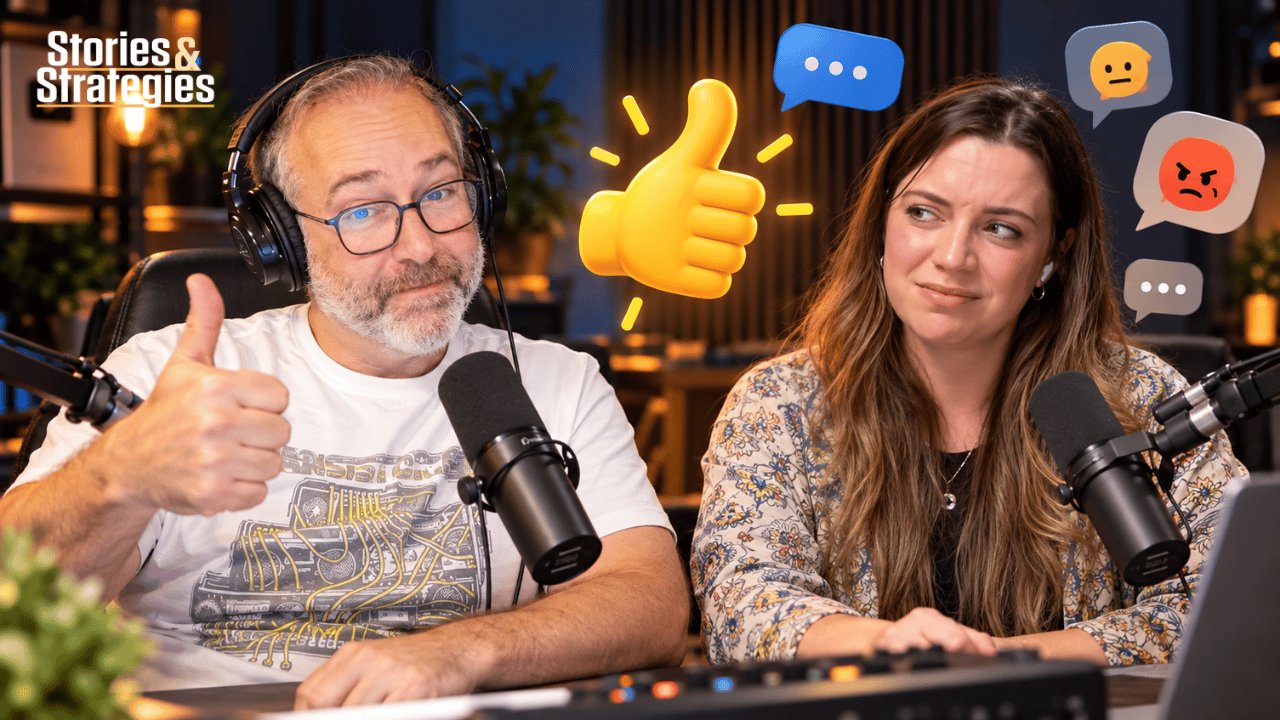
You also are the host of Statista's Off the Charts podcast, which I checked out and I love, which means you've spent more time than most professionals arguing about what a thumbs up actually means. So thumbs up to you being here.
Stacy Jo Dixon [03:15] Thumbs up.
Doug Downs [03:17] Your research shows that 77% of office workers, three out of four in the US and the UK say they feel some kind of need to use emojis at work. I am presuming that means in their emails and I guess their texts.
That's a huge number for something that a lot of people, at least some, still say you don't use the smiley face. I've even heard Gen Z kind of thinks less of people using the smiley face, but we do feel a need to use them. What did you find?
Stacy Jo Dixon [03:49] Yeah, that's absolutely true. So thumbs up emojis, unfortunately, if you like that emoji, it's not one of the favorites. I would say probably across all generations at this point, but especially Gen Z.
I'd actually really like to start by telling everybody about the emojis that you should not be using in the workplace. And I don't think there's any surprises here to be honest. So avoid the eggplant emoji in the workplace. Avoid the poop emoji, even though it has a little smiley face, you don't want to be using it in the workplace. Peach emoji, kiss mark emoji, and sweat droplets emoji. So these are the ones that should be on your list of, I'm not going to use these in the workplace.
Doug Downs [04:35] Are they cringe? Is it just you can mistranslate the idea?
Stacy Jo Dixon [04:40] Yeah, they're cringe. And there's also a flirty element to most of these as well.
Doug Downs [04:45] The peach one, I know. So just avoid them. Yes, yes, yes.
Stacy Jo Dixon [04:48] Yeah. We want to stay professional in our workplace communications, so just avoid them.
Gen Z in the workplace, they don't like to use crying emojis for when they're actually upset. Kind of like, yeah, we're not actually crying, but people could take it as, oh, tears falling from this emoji, this person's upset. It doesn't mean that. Gen Z also do not like the kiss emoji or the wink emoji.
Doug Downs [05:16] Okay. Laura in your office, I sent her an email earlier today and top of mind, I'm pretty sure she gave me a thumbs up.
Stacy Jo Dixon [05:24] Really?
Doug Downs [05:25] Yes, I think she did, which was cringe. I totally cringed when I saw it. Anyway.
Okay, so I get why some of those, it's the mistranslation, the crying emoji when it is actually sad, that totally cringe. I get that. What are the good ones to use? And you have something you would call emoji literacy, and I think you're taking me down that path.
Stacy Jo Dixon [05:49] Yeah, emoji literacy. So Gen Z are more likely to change the emojis that they use for the situation. So they know what's appropriate, what's inappropriate. If they're communicating with older generations, they'll probably be the ones that will most hold back on emoji usage because they know things can be misconstrued. Whereas I think older generations, they will use the thumbs up and maybe get eye rolls from their Gen Z colleagues because this is just a sign. It's not very cool anymore. It's also kind of the dad emoji, I think, to get this thumbs up. Yeah, it's low effort emoji usage.
Doug Downs [06:33] Okay. All right. The heart, am I allowed to use the heart? And is there a difference between using the red heart and the blue heart? I tend to use the blue one in case the red one gets misunderstood.
Stacy Jo Dixon [06:45] Yeah, I suppose it seems a bit softer to use a different color. The red heart emoji, again, you're showing your age if you're using this emoji. Gen Z, really like the hands making the heart sign. I'd say that's the safer option at the moment.
Doug Downs [07:03] Okay. Okay. Temporarily, the hell with Gen Z. Tell me about the other generations and the separation of genders, and are there any cultural separations there as well?
Stacy Jo Dixon [07:15] So when we look at gender, women are more likely to use emojis in their workplace communications. And for myself and female colleagues, I think this purely comes along with not wanting to be misunderstood or not wanting to come across as too short in our communications. Women are more likely to say please and thank you too many times when it comes to our Teams messages or emails because that's just the way that we are communicating. So we're more likely to use emojis to soften our language.
Doug Downs [07:55] Agreed.
Stacy Jo Dixon [07:56] I don't think that's a surprise to know that. We're always softening our language for various reasons.
Doug Downs [08:01] There's a check-in mechanism with a lot of women. Are we good? Not men do it too, but not to the same extent. Are we good here kind of thing.
Stacy Jo Dixon [08:10] That's it. Yeah. It's like a double check.
When it comes to international colleagues, we were surprised to find that some of our colleagues from the Middle East, the thumbs up emoji is very offensive to them. Obviously they are international colleagues. They know that it's used here sometimes. They don't take it offensively, but we were surprised to find out actually in our country you wouldn't use this to communicate.
Doug Downs [08:40] So they can take it as an obscenity of sorts? Yes. I think you were mentioning. Yeah. Okay. But the younger generation in Middle East cultures just sort of eye roll and sort of accept that that's where you're going. Yeah. Okay. And the generational differences, you said old guys like me tend to use the lazy thumbs up, which we think everybody uses it, right? I'm using it because I'm not going to offend anyone, but the simple fact that I'm using this lazy emoji means I didn't put any creativity into it.
Doug Downs [09:14] Yeah, I think that's the key point. It's the creativity. It's the first one along that you can click. It's kind of like saying, "Yeah, I recognize your message," but it's sensing the low effort, I think.
I am guilty of using it sometimes when I just want to let somebody know, "Okay, I've seen this message. I will get back to you, but I can't do it now." I think it's okay. I don't think every time you use this emoji you're going to offend someone, but I think to go the extra mile, maybe select a different emoji can just make workplace communications way more fun, way more personable. And again, just that extra little bit of effort seems to make a difference because our brains, we've looked into how people react to emojis as well. Our brains will recognize visuals before words. So the small image, that tiny image that takes you a few moments to select, it's going to let somebody know your intentions way quicker than them reading a message or maybe reading too much into a message. The emojis can kind of cut a lot of time and it is kind of a way of being more direct because you're letting people know how you feel much quicker.
Doug Downs [10:38] Interesting. And yet we've been using emojis 20 some odd years or if you look at the smiley face button that goes back even further. I wonder if we get weary of these and I'll give you an example. I have a tendency to want to use the smiley face emoji in an email where I don't have resting bitch face, but I have resting email bitch face, and I know that sometimes the tone of my email can absolutely come across as acerbic or pushy or strong. I get that. Whereas the way I'm meaning it is I've taken the time to look at this, you've hired me to provide coaching or counsel or strategy, here it is. So I tend to communicate blunt and I'll pick the sentence that I think I need to shape an emotion around and I'll put in the smiley face. But as you're speaking, I'm wondering, because I have an example from a year ago where I royally pissed off a client for doing exactly that.
They took it as condescending, so to speak. Really?
Stacy Jo Dixon [11:48] Yeah.
Doug Downs [11:49] Yeah. No, they did. They did. I was giving them a crap sandwich of some kind and it only made it worse. So I wonder if all of this is evolving at the same time.
Stacy Jo Dixon [12:02] I think it is evolving. I think it would be unusual for somebody to be offended by a small smiley in an email, especially if you're being slightly brief and you want to soften it by adding that smiley face. That
Doug Downs [12:18] Was my intent.
Stacy Jo Dixon [12:20] Yeah, that's really, really interesting. I mean, perhaps there was a generational or a cultural thing there that you were not aware of. So maybe in email, I do think it's a little bit different. I think we have to be careful in email. I still think we expect that more formal communication.
Doug Downs [12:40] Let me ask you about, I hate to create a class system, but in one lens I can communicate down, which is not down. I don't mean it as down. I can communicate sideways and I can communicate up, which is not really up, but you know what I mean. When is it okay for me to use an emoji when I'm communicating down, when I'm communicating sideways, and can I use it when I'm communicating up and how far up?
Stacy Jo Dixon [13:08] Yeah, to use your terms like down and sideways, absolutely. I think it's just a really friendly way of maybe feeling like team spirit. We're all in this together, let's not make it so formal to communicate. I think that's absolutely fine. I think with higher ups, you will see less of a range of emojis used, and I think then the thumbs up is absolutely fine. It is more formal and it's more direct and it's not really making anything too personal. It all depends on that relationship, how that relationship is at that moment. I think with higher ups, maybe wait for them to use that type of communication and then that's your green light to use that.
Doug Downs [14:00] That's a good cue.
Stacy Jo Dixon [14:01] Yeah, it's a little bit different there. It's like with a client, you should wait for them to maybe take that first step and then that is how you would respond because it's not for everybody still. It's not for everybody.
Doug Downs [14:13] I could take emoji literacy to translate into guidelines or my God, even policy. So if I'm a comms lead, I could create guidelines. If I'm an HR lead, I might, ooh, a new policy. Don't use the thumbs up. There's a cross-cultural risk to that. Where do you see that going? What's your actual advice?
Stacy Jo Dixon [14:34] I think to make a policy. So just to use that example, to create a policy for thumbs up, I think, where does that end? You know what I mean? Because there's always going to be some emoji that offends somebody. So I think, yeah, where does that end? But I don't think that guidelines are a bad thing.
Doug Downs [14:54] Policy,
Stacy Jo Dixon [14:55] I don't think we're there yet, but guidelines, absolutely. And it can be communicated again in a nice, light, fun way. Don't use the eggplant, don't use the peach. I think that can be communicated in a nice way and maybe could stop some embarrassment between colleagues.
Doug Downs [15:18] It must be me being naive. I totally get the eggplant thing I'm not asking or the peach thing, I'm not asking, but the eggplant thing, I genuinely don't know, but I'm not going to ask because that just creates some awkward.
Stacy Jo Dixon [15:29] Just trust me on that one.
Doug Downs [15:30] I won't. I won't use the eggplant. When I was just a second ago explaining in an email, I did tick off a client. I'll be totally honest, I think part of it was my client is a female in their 30s and I'm a male in his upper 50s and I'm constantly vigilant about, for God's sakes, don't get caught mansplaining, but at the same time, I'm in a strategy and coaching role. Well, that works the other way too. When you are a younger person communicating to an older person, I don't care if it's down, sideways or up, does that create a different context for as a younger person, if I throw in an emoji, are they going to think less of me? Are they, oh my God, emojis. What is wrong with this generation?
Stacy Jo Dixon [16:18] Yeah, and I've heard them types of comments before. So even when I'm writing on LinkedIn, I think emojis make it more fun. I think it's a great way of breaking up different parts of a paragraph. And older colleagues have said to me, "Oh, I can't stand this emojis. It's too much to look at." So not everybody's going to agree on this, but I think they're here to stay. You can see how it's really gone from, okay, we use them on WhatsApp, we use them for communicating with friends and family. And I do think that around the pandemic when so much went virtual, I think it was just a more friendly way of everybody still just feeling a little bit together to send a nice little creative image, smiley face, whatever it might be. I think that's when, I don't have any figures to back this up, but from my research, I think that's when emojis in the workplace became very common.
Doug Downs [17:26] Where do you see emoji use as being okay? We talked about email, text, social media. In fact, social media encourages it, and the thumbs up being the primary one that every single one of them encourages, but is it okay in a report? Is it okay in a communications plan? Is it okay in a survey? Where do you see that? Is there a line and where does that line get drawn?
Stacy Jo Dixon [17:49] I think it completely depends on who that survey, report, email, brand
Doug Downs [17:56] Communication,
Stacy Jo Dixon [17:57] It depends on who it's for. As you've just said, perhaps older generations, it's going to turn them off from what it is they're reading. For younger generations, it might keep them more interested. And if you're using the right emojis, then you're going to be really, really speaking to your selected audience if you get that right. So again, that depends on who your target audience is. It's the kind of thing, if you get it wrong, you can really get it wrong, but if you get it right, you're going to resonate with the exact audience that you want to reach.
Doug Downs [18:33] And really, emojis, in some sense, they're not new and they're not just a language of the computer age because hieroglyphics might've been the original emoji, so to speak. This probably goes back tens of thousands of years, or at least as far back as you think is possible.
Stacy Jo Dixon [18:53] Yeah, I think that's a fantastic point. I think it is, it's like we started with hieroglyphics or whatever came before that, and then we've kind of looked down on for a while, emojis being in our language. I think even people assumed that these types of emojis were negatively affecting our communication and the written word, maybe a threat to the written word, but we are using them more and more. They're becoming more and more acceptable. So there is a kind of a full circle moment here for human communication.
Doug Downs [19:29] I'm all smiley face. I really appreciate your time, Stacy. Keep us abreast of everything happening at Statista. So many good things.
Stacy Jo Dixon [19:35] Yeah, it's honestly so nice to chat with you. So nice to chat with you and meet another emoji enthusiast.
Doug Downs [19:43] I second that emoji. Yep. Here are three shareable moments I got today from Stacy Jo Dixon. Number one, read the room. The use of emojis should change depending on the audience, the relationship, the generation, and the culture. Number two, use emojis to clarify tone. The right emoji can quickly soften a message and make your intent a lot clearer. And number three, follow their lead with clients or senior colleagues. Wait for them to use emojis first and take that as your cue. If you'd like to send a thumbs up or a smiley face to my guest, Stacy Jo Dixon, we've got her contact information in the show notes. We also have a link to her podcast and a link to that statistic study. Stories and strategies is a production of Stories and Strategies podcast. Thank you producers, Emily Page and Jocelyn Floralde. I'm holding my palms together in the universally recognized emoji for thank you.
Doug Downs [20:42] Lastly, do us a favor, forward this episode to one friend. Hey, thanks for listening.