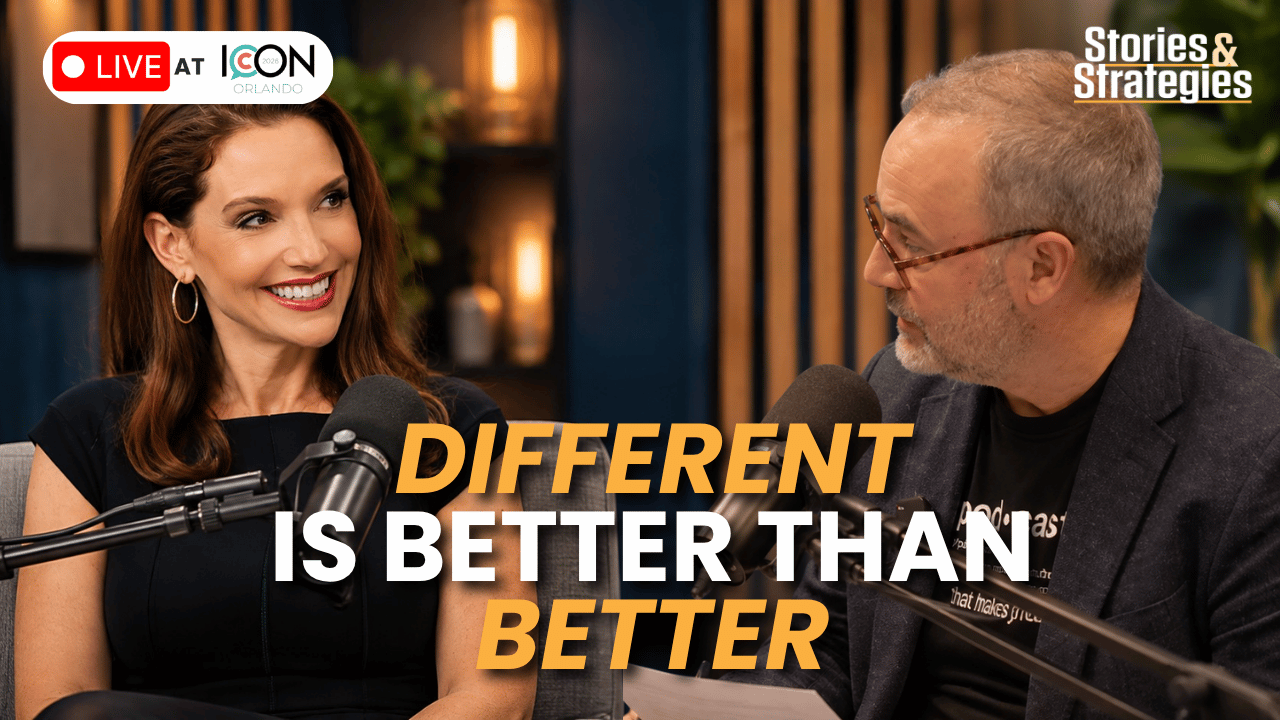
Emily [0:00] In public relations, different is often better than better. No better place to prove that than at the liquor store.
Doug Downs [0:14] Walk down the aisle of almost any liquor store. Hundreds of bottles, elegant labels, rolling vineyards, French chateau, gold medals... Every one of them insists the wine inside is better than the one beside it. And then you see it. One bottle, a criminal's face. The brand is called 19 Crimes, and every face on every label belongs to a real convict sent from Britain to Australia in the 18th and 19th centuries. Thieves, rebels, people who broke the law and paid for it. Now, open the app. Point your phone at the label. The convict moves. He looks you in the eye, and he tells you his story. [1:01] THE CONVICT (19 Crimes app voice): I was banished to Australia for crimes against the crown. They believed my story was over. But it was merely the beginning.
Doug Downs [1:11] You're not shopping for wine anymore. You're meeting a criminal, and people kept coming back. From 2017 to 2019, the company says its case volume grew by about 40%. The brand has sold millions of cases. Now, is it better wine? Speaking as someone who knows firsthand, definitely not. It doesn't matter. Nobody reinvented the grape. They reinvented the reason to pick up the bottle. And while every other winery competed on taste, tradition, prestige... 19 Crimes competed on fascination. Today on Stories and Strategies: why the best bottle in the aisle is rarely the most wanted. My name is Doug Downs, here at PRSA ICON 26, Orlando, Florida.
Doug Downs [2:06] Sally Hogshead, it's so good to meet you.
Sally Hogshead [2:08] So great to meet you, Doug. Thank you for giving me the opportunity to talk with you. I'm looking forward to it.
Doug Downs [2:12] Sally, you're a two-time New York Times bestselling author, founder of How to Fascinate. Your ICON keynote today was called The Fascination Factor: authentically communicating who you are best. And you really dig into the science of what makes someone, something, or some organization fascinating within that 2.7 seconds that we all need to get to the finish line. How can it be more fascinating?
Sally Hogshead [2:47] Sure. Well, have you ever walked into a room and wonder what kind of first impression you're making, and you're having trouble reading the room, and you're not sure — should I be the funny one? Should I be the introspective one? Well, I took a step back, because I had those same questions too. And I pulled upon my background in advertising. Now, in advertising, we have focus groups. It's that room where everybody's eating sub sandwiches and the two-way mirror, and there's a moderator asking questions. And the questions that the moderator is asking — they're trying to find out what are the conscious or unconscious motivations for decision-making. So they'll hold up a can of Coke and say, what are the emotions, the recollections, the references that you have? Now, Pepsi. What they're doing is... they're quite different, those two.
Doug Downs [3:34] Yes.
Sally Hogshead [3:35] I mean, I don't want to tangle, but I grew up in the South and I'm a Coke girl.
Doug Downs [3:40] Right.
Sally Hogshead [3:41] Coke evokes a lot of emotion, right? It does.
Doug Downs [3:44] And it's 99% the same formula. One is citrus, one is vanilla.
Sally Hogshead [3:48] Yes. So, similar to a focus group, I thought, well, if we can measure a brand quantitatively — we can actually measure how somebody perceives the traits of Coke versus Pepsi — why can't we do that with people? I spent three years, worked on an algorithm, and found that we can measure how people perceive you. So it's a test that you take that gives you a report that describes — just like an advertising agency wrote the report — how does the world see you? How do they see you at your best?
Doug Downs [4:23] You know what's coming immediately to mind when I think How to Fascinate, and fairly quickly, is my AI prompts in 2026, because I do ask it to help create imagery or to create script, and I say it needs to be an identity moment for whatever my audience is, or it needs to evoke an emotion — be that sadness, anger, or simple curiosity. Am I on the right track for the most part when it comes to fascination, touching the amygdala and pulling something out emotionally?
Sally Hogshead [4:56] Emotion is always great. AI is not always great. And the reason why — and I'm sure you know this — we're all kind of having a love-hate relationship with AI right now. AI is only drawing upon what already exists. AI doesn't have opinions. AI can only create an amalgamation, like lowest common denominator of the prompts that you give. So I mean, I use it, of course, but we're not going to use it to do the essential heavy lifting that every brand and every message needs, which is: you must have an opinion of authority. AI will not give you an opinion. It can only reflect what has been judged as the criteria in the past.
Doug Downs [5:36] And that leads to your great phrase, different is better than better. And the mental imagery I get is the red M&M in the bowl of blue M&Ms.
Sally Hogshead [5:49] Yes. Anything that stands out to the right target audience for the right scenario is great. Let me describe what I mean. AI can't give you an opinion. It can give you feedback on what you think. But today what matters the most is for you to be able to have a crystallized point of view that is slightly counterintuitive, that doesn't agree with your competition, but brings forth something in your brand. There are two criteria. First one is: your opinion must be for a very specific audience at a very specific scenario. And I'll give you an example. Here in the U.S., when you buy hydrogen peroxide at the pharmacy or the drugstore, what color is the bottle of hydrogen peroxide?
Doug Downs [7:21] It's white, isn't it? It can be white or brown.
Sally Hogshead [7:24] So it can either be clear or brown. Right. I recently was buying hydrogen peroxide, and I saw right next to it there was a product named Boo Boo Bubbles that was in this cute light blue chubby — looked like a toy that you would get for your four-year-old. And when I looked into the branding, it's because kids get scared of hydrogen peroxide because they associate it with boo-boos. So they developed a competitor: Boo Boo Bubbles. Well, the price of hydrogen peroxide, 79 cents — the price of Boo Boo Bubbles is $5 for a much smaller container.
Doug Downs [8:03] Yeah, but my kids feel better.
Sally Hogshead [8:05] But your kids feel better. I put a price on my kids. That's exactly it. Hydrogen peroxide's about what's inside the bottle. Boo Boo Bubbles is about the experience outside. So this is hard for PR professionals. And find out what your differentiating factor is for you personally, which I think leads back to that test, right? What is it I'm naturally different and yet still part of society about?
Doug Downs [8:34] It's hard for PR, because they're — especially younger or mid-level PR — because they have to pitch upwards, so to speak. And that's older, normally. And they tend not to approve things that are different. They tend to go, what have we done before? Well, let's do that again.
Sally Hogshead [8:53] Yeah. I mean, you know, first off, committees are the death of an original idea, because we talk about lowest common denominator. Well, here's the thing. Imagine that we have a pitch that we have to make to an older client. There are many different types of personalities that could make that pitch. It could be done through passion. It could be done through detail. It could be done through research. It could be done through listening. That's what we're measuring with the Fascinate test. What is the way in which you are most likely to have a successful meeting in that room or in that office? But here's some specific tips on what I call selling up. First thing is: always present a bell curve of ideas.
Doug Downs [9:37] Yeah, yeah.
Sally Hogshead [9:39] Well, it's slightly different. To say: I'm going to show you some ideas that are too safe, and I'm going to show you some ideas that are too outrageous. But here's what I want to tell you. If you don't have the biggest budget, you can't have the first half of that bell curve. You can't have a safe idea, because a competitor has already said it with more money for more awareness. So you've already lost. You might as well donate the money to charity. We are going to have to do something that's in the middle or over. So then what you're doing is you're strategically outlining the cost of safe, traditional ideas that are simply repeating what the category owner has already said.
Doug Downs [10:37] And you can get that from ChatGPT, as you said off the top.
Sally Hogshead [10:41] Oh, yeah. I mean, it looks not as cheap, but insight is... I mean, I'm sure working with you would be expensive, but insight is the key.
Doug Downs [10:50] Just a little.
Sally Hogshead [10:51] Bringing something new to the conversation that hasn't existed yet is the single greatest way for us to break through in a distracted, crowded market. And I'm going to use the A word, which sometimes annoys me. We say "authentic" — because we didn't say that for thousands of years. But that really is the nub of it: be yourself. Be the -iest you.
Doug Downs [11:14] I'd love to find in Roget's thesaurus — if anybody still knows what that is — I would love for any different words than "authentic," because like you're saying, it is... being authentic doesn't mean that you're great. You can be a total jerk and continue to be a jerk. You can be boring and continue to be boring, and you're authentic because you're being boring.
Sally Hogshead [11:37] I'd like to try to reframe it, to use words more like "distinctive identity." Distinctive identity that is true to who the brand is or who you are. So you're bringing it out. An example: there's a little surf town here in New Smyrna Beach in Florida where I live. It's like surfers, bait shacks, and that's pretty much it. There's only one bridge in and out of town. And that bridge — ding, ding, ding — it has a drawbridge for the sailboats. So no businesses are succeeding around the bridge because, you know, the cars with all the emissions. Well, this little surf shack created a deal: bridge up, beer down. So ding, ding, ding. As soon as you hear the ding, beer is 25 cents. And then as soon as the bridge is closed, beer goes back to being its regular price. They took a seeming disadvantage, turned it into an advantage. So now people go to this surf shack because it has this new advantage. It's like a Pavlovian response all of a sudden.
Doug Downs [12:27] Yeah. Can I fascinate people and be an introvert? Because I am actually an introvert who, like so many, plays a role for a certain battery period of time in the day, right? But if I'm an introvert at these public gatherings or on a presentation stage, can I still be fascinating?
Sally Hogshead [12:51] Absolutely. And even more so in a world that is noisy, crowded, overstimulated. We have enough people shouting. We have enough people jumping up and down and asking for attention. What we need are thoughtful, genuine, sincere observers and thinkers who can actually bring value to the table instead of it being just more and more messages. There is a human equivalent of AI slop, which is talking just for the sake of talking.
Doug Downs [13:18] That's really good. And the sole practitioner — how do they step forward and prove themselves from a value-based model perspective? And I'm always coming back to, because the hourly model is really going the way of the dodo.
Sally Hogshead [13:36] Yeah. The hourly model is really difficult. You need to be either — you're paid for your results, you're paid for the ideas that you contribute. But let me come back to what you were saying with this sole practitioner. There can be sometimes the identity of the practitioner merges with the identity of their firm brand, because they are the brand. If there's only you, you're not modeling after a team. So it's important for you to know that if you are the figurehead — whether it's your name on the signage or not — what are the ways in which you have an innate advantage, a way of being able to over-deliver and outperform that already gets you out of bed in the morning? Is it your ability to come up with a lot of ideas really quickly? Or is it your ability to think deeply and go into analysis? Don't brand your company's benefit on deep analytical spreadsheets if the value you provide is through effervescent bonding.
Doug Downs [14:39] Right, right. Back to the test that you talked about off the top. That's on your website?
Sally Hogshead [14:43] It is not on my website. It's $79 U.S. And I would love for you guys to be able to, for a period of time, have a free invitation — a complimentary invitation. And I happen to know that there's somebody standing near me who will make sure that... that you get a code.
Doug Downs [15:20] That you get a code? And that's for the... not just me. That's for the person listening.
Sally Hogshead [15:25] Not just for the audience.
Doug Downs [15:28] And you take that... What it's measuring is the Fascinate test.
Sally Hogshead [15:31] What it's measuring is how do other people see you at your best? Just as a focus group identifies what makes Coke better or different than Pepsi, this is measuring what are the communication patterns that you consciously or unconsciously send — in a pitch, with your clients, with your family — that can be dialed up and dialed back to make sure that you feel effortless and in the flow.
Doug Downs [15:57] Okay. Is that hard sometimes for me? Like, I think when I walk in a room I look like Bradley Cooper. Now, I'm 6'1", and you know, full head of hair, and a six-pack. That's my read, but apparently... my wife tells me no. That's not the image I'm projecting.
Sally Hogshead [16:11] Charm comes in many... Something that you asked earlier was: do introverts have a disadvantage? What we find is people who score high in being able to logically think through with problem-solving, think before acting, draw in much closer relationships that are increasingly rare in a crowded, AI-slop world.
Doug Downs [16:28] Okay. Go to the link that's at the top of the show notes. It's going to be a trackable code, okay? So Sally and team are going to know who specifically from the podcast have clicked on that. So do me a favor and go and take the test — and it's free. It's only three minutes. Don't be aspirational. Don't be aspirational in filling it out. You can't game it. Fill it out raw, authentic as best you can. I would love to reconnect with you later and we'll find out what are the patterns within your audience.
Sally Hogshead [17:08] Done, done.
Doug Downs [17:09] You are fascinating. How wonderful. Thank you for your time.
Sally Hogshead [17:12] Thank you, and I appreciate the invitation. And, you know, after you invited me so kindly to be able to have this chance with you — I did go in and watch your podcast and listen to your conversational style.
Doug Downs [17:24] And you still came.
Sally Hogshead [17:26] Definitely. I look forward to next time.
Doug Downs [17:29] Here are three talk-about moments that I got in this episode from Sally Hogshead. Number one: different beats better in a crowded marketplace. A distinctive point of view is more valuable than simply doing what everybody else is doing, just only better. Number two: playing safe is risky. When competitors have bigger budgets, conventional ideas won't get you noticed. So you need to make the case for being bold. And number three: know what makes you fascinating. The -iest you. Your greatest advantage comes from understanding how others see you at your best, not trying to become someone you're not. If you'd like to send a message to my guest, Sally Hogshead — we've got her contact information in the show notes. Stories and Strategies, a production of Stories and Strategies podcast. If you liked the episode, leave us a rating, possibly a review. Thank you to gold star producers Jocelyn Floralde and Emily Page. Lastly, do us a favor: forward this episode to one friend. Thanks for listening.