Lady Emily [00:10] This episode is about earned media, why it still counts and why it counts more now that anyone can publish and any machine can answer. If you work in public relations, it starts in Paris in the mid '70s.
Doug Downs [00:30] May 24, 1976 in Paris, nine French judges sat down to taste wine, a blind taste testing French wines against California wines. A local wine shop owner had set up the stunt. He wanted publicity and more customers. And I mean, there was no risk here. Every self respecting Parisian knew the French wines would win. Nobody in Europe had even heard of these California wines. The wine shop owner invited the press. Yeah, but only one reporter even bothered to come, George Taber of Time. He covered Paris for the magazine. The others didn't bother because I mean, really, this was such a nonstory. Blindfolds in place, the judges swirled, they spat, they scored. And when the scores were added up, the top white, a 1973 Chardonnay from Chateau Montelena, Napa Valley, California. It sold for about $6.50. The top red, a 1973 Cabernet from Stag's Leap. Also, California, a winery only six
Doug Downs [01:40] Years old. California had taken both. Taber wrote it up, a short piece for Time. He said the unthinkable had happened. In Napa, well, the phones, they started to ring. The wines hadn't changed, but now the news was out. Someone else had said it. French judges after all had admitted to it. Chateau Montelena said that story rocketed them to fame. Investors started piling into Napa Valley. At the time, there were roughly 67 wineries in Napa back in '76. Today, there are over 400. In California statewide, some estimates say there are as many as 6,000 wineries. Now think about this. What if Taber had never gone to that event with no media, it would really have been a nonstory. Earned media made the difference and it can sure have impact still today. Today on Stories and Strategies, the strategy for earned media despite the proliferation of AI, it's aging rather well, I would say.
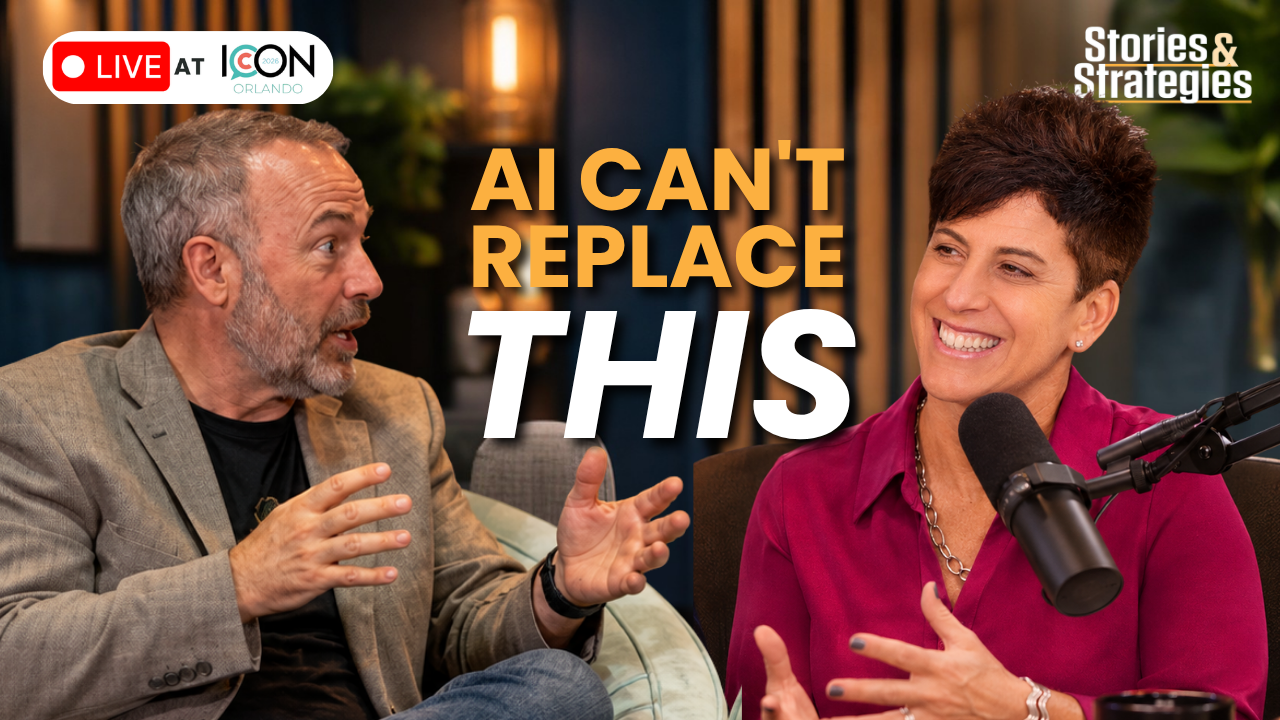
Doug Downs [02:58] My name is Doug Downs, my guest this week here at PRSA ICON in Orlando, Florida. Jennifer Bisbee.
Jennifer Bisbee [03:04] Yep. I am not wearing my Mickey Mouse ears, but I am a fan.
Doug Downs [03:08] Aren't we all?
Jennifer Bisbee [03:08] Always a fan and former client, always a good client. So yeah, just great to be here. Thank you for the opportunity to chat and learn more from each other about the State of the Union and PR.
Doug Downs [03:19] I'm looking forward to this. We both have media on the mind. Jennifer, you have your APR, you are the president of the Orlando based Bisbee & Company, more than 30 years in media relations. Your ICON session, which was just yesterday, called Why Media Relations Matters More Than Ever in the Age of AI. And we ran an episode, it's probably about five years ago now. I don't think things have changed, but not in this context, called media. We don't need no stinking media.
Jennifer Bisbee [03:50] Right, right, right. When I was putting together my session, I was having a really good time with... At the beginning of my session, I talk about my career over 40 years as the tools and technology have evolved to reach media. And so I've done a lot of media relations over the course of 42 years. And for a while there, I was getting really sad. I didn't know whether my professional expertise in this particular area was going down the tubes because we could see newsrooms shrinking, content rising and content everywhere. And certainly podcasts, of course, being a wonderful new channel for us. It's kind of a lot of content everywhere and trust becoming scarce. And so many of us have all been kind of lamenting what's going to happen. We don't even think in media. What are we going to do when there's no one left in the newsroom to pitch? That's
Doug Downs [04:43] A riff on what we think of as mainstream media and that you're going to use other channels. But am I media? I have a podcast.
Jennifer Bisbee [04:51] I
Doug Downs [04:51] Think
Jennifer Bisbee [04:52] You are media. Absolutely, you're media. I think any media, whether it's paid, earned, owned or shared media is how we influence behavior. But earned media is certainly kind of the, I call it the killer app of PR professionals because we are the media relations experts. But what I shared yesterday is that media relations matters more than ever in the age of AI. And at least for now, it could change of course, but for now, journalism and third party credibility is currency. Media relations is how we make deposits and it is the most discoverable and the most cited when you go into AI engines and type in questions. So who's the best podcast in the world? If you've had third party credibility and coverage, whether it be through fellow podcasters, through traditional media, it's going to rank you higher than the things you say about yourself.
Jennifer Bisbee [05:48] And so media relations still very much is a very important piece of the puzzle, but it shouldn't be the only piece of the puzzle.
Doug Downs [05:56] I'm a former journalist. I don't consider myself a journalist because I've been to university and I know what I believe small J journalism is. Supplemental to that, I'm not sure there's a whole lot of real journalism happening out there anymore. There's an awful lot of editorializing.
Jennifer Bisbee [06:17] There is. There absolutely is. And there's a lot of skepticism and doubt in the legacy media. They really have an issue and they have a problem. They were slow to adapt in the digital age where everybody else was hopping on the internet and beginning to get content. And of course with social media and then eventually podcasts, the legacy media were very slow to adapt and to figure out their monetizing other content. Now there's paywalls and we all haven't quite figured that out yet either.
Doug Downs [06:49] No.
Jennifer Bisbee [06:49] Because the New York Times article isn't cited, does it really matter that you get your client in the New York Times?
Doug Downs [06:55] Great point. And paywalls frustrate me because as a former journalist, I do understand I should pay for good journalism. My problem is I'm not sure I'm still going to get it even after I pay.
Jennifer Bisbee [07:07] And when you say pay, you're either going to pay, meaning someone on your team is going to foster those relationships and get news coverage, or you're going to pay a consultant like me who knows how to work with reporters and generate those stories. But AI has become this fabulous new tool for us. I'm getting excited again about being in media relations where before I was getting very sad because now we have this fabulous new tool to help us really fine tune where the journalists are, what their beats are, make sure our pitch is relevant to them and just really dial it in a lot better than we ever could before. So it's a terrific tool, but it can't take the place of sound judgment and instinct.
Doug Downs [07:52] I get asked this all the time because we have about 25 podcast clients. How do you make your pitch stand out? I get across the 25 clients, it is close to 50 pitches a day.
Jennifer Bisbee [08:05] And it's going to be even more difficult because
Doug Downs [08:07] My AI is starting to review these for me. Totally,
Jennifer Bisbee [08:10] Jennifer. 100%. The agents are going to become the gatekeepers where before the journalist was the agent. We have to convince agents as much as we have to convince humans not to throw us out of the inbox, right?
Doug Downs [08:24] So my answer to that used to be create a human relationship with the receiver, and then that kind of centralizes functions that will make the pitch for you because they know them. But if the AI is the agent...
Jennifer Bisbee [08:39] We're in the early kind of the dawning of the new age of Aquarius when it comes to agents who are all still kind of learning this. But to me, I've been a big fan of WIIFM my whole career. What's in it for me? And I don't think those old skills have gone out of style. We've got to go back to the roots to go, okay, who's the target audience I'm trying to reach? Which news media outlets or traditional, nontraditional podcast social, whatever it takes, how do we laser focus into those audiences with the right messages? And then dial in or what's in it for that human being on the other side of that agent? They're busy, traditional reporters, busy, they have a deadline, they need to get information that's relevant to them. And so I think we've got to go back to that. We also have to put a human voice behind that pitch.
Jennifer Bisbee [09:28] I think it was like 56% of journalists are rejecting AI driven pitches, so we've really got to turn them into with our own voice.
Doug Downs [09:37] Good. Crisis comms. What does media relations look like now in a crisis world, especially with AI right here and accelerating the misinfo?
Jennifer Bisbee [09:47] It's a great story, a great question. And again, back to agents, and this is something I'm really learning as fast as I possibly can ingest it, is agents can actually monitor your news for issues management in real time. Now I'm not talking about a huge breaking crisis, like God forbid, an active shooter or something like that. We'll put that aside, but for just general issues management as a story's unfolding, we literally have the resources and the tools now to monitor that news in real time so we can know where we are on the trajectory. So from a monitoring perspective, I think AI agents are incredibly important. From a influencing news media, I think that's maybe part of your question, how can we really influence what they're covering? Again, I think it's really important to get back to basics. It sounds really, really boring, but it's the truth.
Jennifer Bisbee [10:35] Have a crisis communications plan ahead of time, work and test your crisis communications plan, have those key messages together, do the scenario so you know what could hit, and then have these agents and other monitoring tools with human beings know how to use them to be staying on top of evolving issues and then when a crisis unfolds, you've got that plan.
Doug Downs [10:56] Okay. You're from an independent firm, so your lens on this is going to be from that perspective, but is it better for me to hire the great big agency on the expensive street in New York or London, or is it better for me to hire the independent firm to help me get the media relations hits that I want?
Jennifer Bisbee [11:11] Boy, that's the million dollar question at all times. I've been in this profession for 40 years. I've worked both for the big international agencies and small boutique firms in my own virtual agency. When I started my virtual company 31 years ago, I did it because I had small children and home office automation, but with great contacts. And what I've learned through the years is it's really about who's going to be working your account and also the capacity that you need. If you are, I'll say Coca-Cola because I actually did some work for Coca-Cola through one of my colleagues, they're going to need more hands on deck, and I can expand or contract my little virtual firm as I need, but they're going to need that big enterprise. But I'm part of a national network of consultants called the PR Consultants Group, and we have a Jennifer Bisbee in every single major market in America.
Jennifer Bisbee [12:00] So I can, I hate to use the word compete because I like to do my own thing, but I can compete with other agencies that need the kind of capacity I can handle and put boots on the ground professionals in every single market. Plus I have the vertical expertise. So if I'm working with a credit union client, I have other experts who I can tap who've got credit union expertise to work with me on that business. And so I think the answer to your question is look at the capacity and look at the breadth of what the client needs, and I'm the first to make recommendations or referrals if it's just too large for me. And you also want to look at who's going to manage your business, who's going to be that day to day contact. So many agencies, and there's a fit for everybody. The big guns or the senior people come in and pitch it.
Jennifer Bisbee [12:52] They may be supervising it, but that day to day person is a younger professional, and that's usually the business model. It really depends on the fit for the client.
Doug Downs [13:02] I've done so much media training just through the course of my career, and when it started in 2001 for me, coming out of media, it was about what are your key messages and training spokespersons within the technical background how to deliver their key messages regardless of what the reporter asked or time, that's changed a lot for me. I no longer try to play jujitsu with the question and spin it into the thing I want to talk about, but that makes it hard. Media relations today, what is my goal?
Jennifer Bisbee [13:34] It's another great question. I think at the end of the day, media relations, just like any other tools in our toolkit as PR professionals is just that. It is a tool. It shouldn't be your only tool in that PESO model of paid, earned, owned, and shared. You've got to make sure you're balancing all of that. But I do think it's very, very important that you stick to your guns in terms of your own agenda and what you want to get across. You don't want to play jiu jitsu, you certainly don't want to be parroting messaging because you want to be able to answer a reporter's question. But at the same time, it's very important to have key messages that are repetitive because that's what these answer engines, they'll give you the higher citation and rating for authority scores for if they can pick up repeated messaging.
Jennifer Bisbee [14:18] And so that's the important piece.
Doug Downs [14:20] Okay. And props to Gini Dietrich, who I know has trademarked that PESO reference, so props to my pal in Chicago.
Jennifer Bisbee [14:26] There you go.
Doug Downs [14:28] And then not relying, but if we're placing a weight of value on placed media relations pieces, broadcast, print, digital, whatever they are, when they get the story wrong, agitatingly, where are you at on responding, fixing, shutting them off? What's your attitude on this?
Jennifer Bisbee [14:51] It's a fine line between them inserting their own opinion or making the story balanced versus straight up incorrect facts. I never hesitate on the part of my clients to reach back out to that reporter to say, "Hey, I want to make sure you have the correct data that you cited in your story. If there's an opportunity for correction, at least online, not in the old fashioned print, please make that correction." But if it is a balanced piece, I certainly will take a look at... And did we do everything right? Did we respond to the reporter's inquiry, whether it was a hostile reporter or not? Did we set some guidelines for the interview? Did my client come across effectively with the messaging? If all those things happened, the reporter is going to have their own agenda. We've agreed to participate in the story, and I think it's very important at the front end to decide strategically if that's an interview you want to participate in.
Jennifer Bisbee [15:51] And sometimes we don't agree to participate because we don't think they're going to get it right.
Doug Downs [15:55] That's right. Yeah. I mean, back a long time ago, you never issued statements. And these days, my God, they're prevalent.
Jennifer Bisbee [16:02] They are prevalent.
Doug Downs [16:03] And it's so important to work with a professional like you because you'll at least have some experience with certain journalists, and we know on that issue, they go red or on that issue they go blue, and that's just how we're going to have to frame our approach to this.
Jennifer Bisbee [16:19] When I do media training and coaching for folks who are going to be interviewed, we always start with making sure the reporter, we vet it, we understand what their angle is, we decide is that our story to participate in, and what is the pros and cons of participating versus not participating, and what are the tools to do that? If I'm dealing with a CEO or a spokesperson who's a little nervous or maybe they don't respond well on the fly, we'll probably lean into a statement. We never want to say no comment. We can politely say, "It's just not our story. It's not our story to participate in," and let the fur fly.
Doug Downs [17:00] It was good to let the conversation fly with you.
Jennifer Bisbee [17:02] Well, thank you so much. I've enjoyed this so much, Doug, and I hope that we have the chance to continue the conversation down the line.
Doug Downs [17:08] Sounds good.
Jennifer Bisbee [17:09] All right.
Doug Downs [17:09] Here are the top three talkabout moments I got today from Jennifer Bisbee. Number one, credibility is currency. AI engines cite what third parties say about you, so earned coverage ranks higher than anything you say about yourself. Number two, you are media too. Media isn't just the mainstream press and a podcast counts, but earned media is still the killer app of public relations. Number three, the basics still win. Know your audience, ask what's in it for them, repeat your key messages, and put a human voice behind every pitch. If you'd like to send a pitch to our guest, Jennifer Bisbee, we've got her contact information in the show notes. Stories and Strategies is a production of Stories and Strategies Podcasts. You could do us a huge favor. Speaking of third party advocacy, if you leave us a five star rating, it really goes a long way. And again, that is perfect, third party.
Doug Downs [18:05] Thank you to producers Emily Page and Jocelyn Floralde. And lastly, do us a favor, forward this episode to one friend. Thanks for listening.