
This is a Serious Change for Podcasting
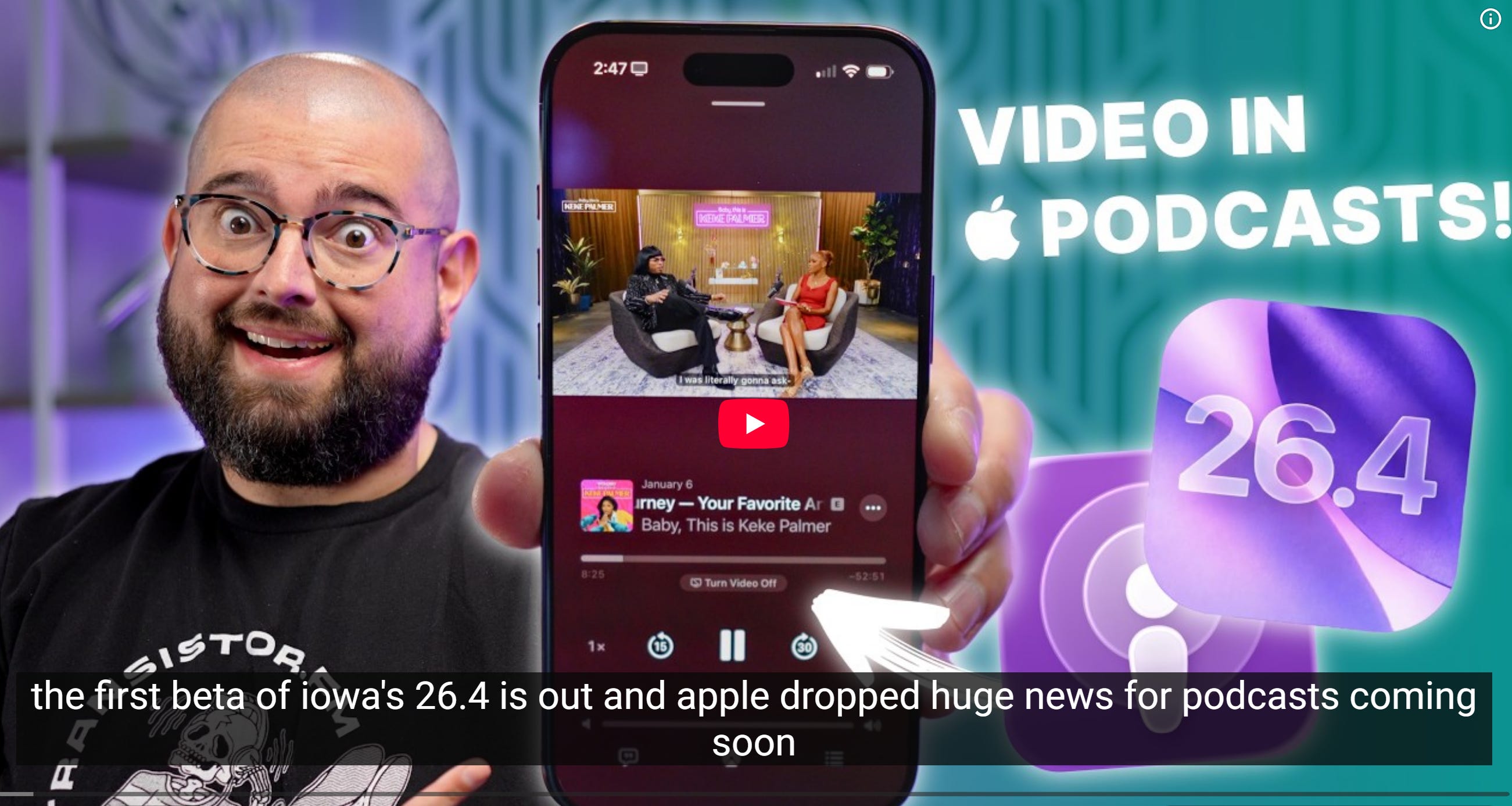
Apple has announced what it’s calling a “transformative update” to Apple Podcasts: native video support built directly into the app.
This isn’t Apple suddenly discovering video. Apple Podcasts has technically supported video for years, but awkwardly. If you wanted to publish video, you typically had to create a separate feed with massive MP4 files. Playback wasn’t elegant. Discovery wasn’t clear. It felt bolted on.
That changes with iOS 26.4 (currently in developer beta, expected publicly later this spring). Apple is introducing a new video system powered by HLS, the same streaming technology used by major video platforms and quite frankly the technical future of video podcasting.
But this isn’t YouTube inside Apple Podcasts.
And Apple isn’t hosting your video files.
What’s Actually Changing
With the new update:
Video and audio can live under the same show feed
Listeners can switch between watching and listening inside the app
Video plays properly in full screen
Episodes can be downloaded for offline viewing
Playback quality automatically adjusts based on connection strength
Video is highlighted inside the app, and it behaves like any other Apple Podcasts feature - playback speeds, Enhance Dialogue, AirPlay, background playback, etc.
However, this is currently only visible in the iOS 26.4 developer beta. Public rollout is expected later this spring.
The Technical Shift (And Why HLS Matters)
Apple is not using RSS to deliver video.
You still publish your show via RSS as usual. But if your hosting provider supports it, they will send Apple a separate HLS playlist for each episode via a private API.
HLS works by breaking video into small segments. The app downloads and plays those pieces one at a time, adjusting quality automatically. Every major video platform uses something similar.
The important part:
The video files remain hosted by your podcast hosting provider. Not Apple.
That means:
Hosting companies can insert dynamic video ads
Hosting companies get more granular playback data
Apple is not ingesting and controlling your video files the way Spotify or YouTube do
This preserves the podcast model of distribution and monetization living with the host, not the platform.
The Business Model Is the Real Story
Here’s where things get interesting/confusing.
At launch, this only works with four hosting providers:
Acast
ART19
Omny Studio (Triton)
Simplecast (SiriusXM / AdsWizz)
All four are both hosting companies and ad networks.
Apple will charge participating ad networks an impression-based fee for delivering dynamic video ads inside Apple Podcasts.
Important clarification:
Apple does not charge for baked-in ads.
Apple only charges when dynamic advertising is delivered.
Apple also is not adding new targeting data. Targeting still works largely off IP address and standard signals, just like audio.
This is the first time Apple Podcasts has directly inserted itself into the ad delivery layer of podcasting.
That’s a structural shift.
What If You Use Buzzsprout, Captivate, Transistor, Spotify for Creators, or Another Host?
Right now, you cannot use the new HLS workflow unless your hosting company is one of the four launch partners.
Buzzsprout does not currently support it.
Transistor does not currently support it.
Can’t imagine Spotify for Creators will ever support it.
Self-hosted feeds do not support it.
Apple is not accepting open HLS feeds via RSS. It requires host participation via API.
So your options are:
Wait for your host to become a partner
Continue using traditional MP4 video feeds
Use alternateEnclosure in RSS for other apps that may support it in the future (Apple ignores this field)
This is the first time Apple Podcasts has launched a feature that is not open to all hosts on day one.
That has not gone unnoticed in the industry.
What Stephen Robles Points Out
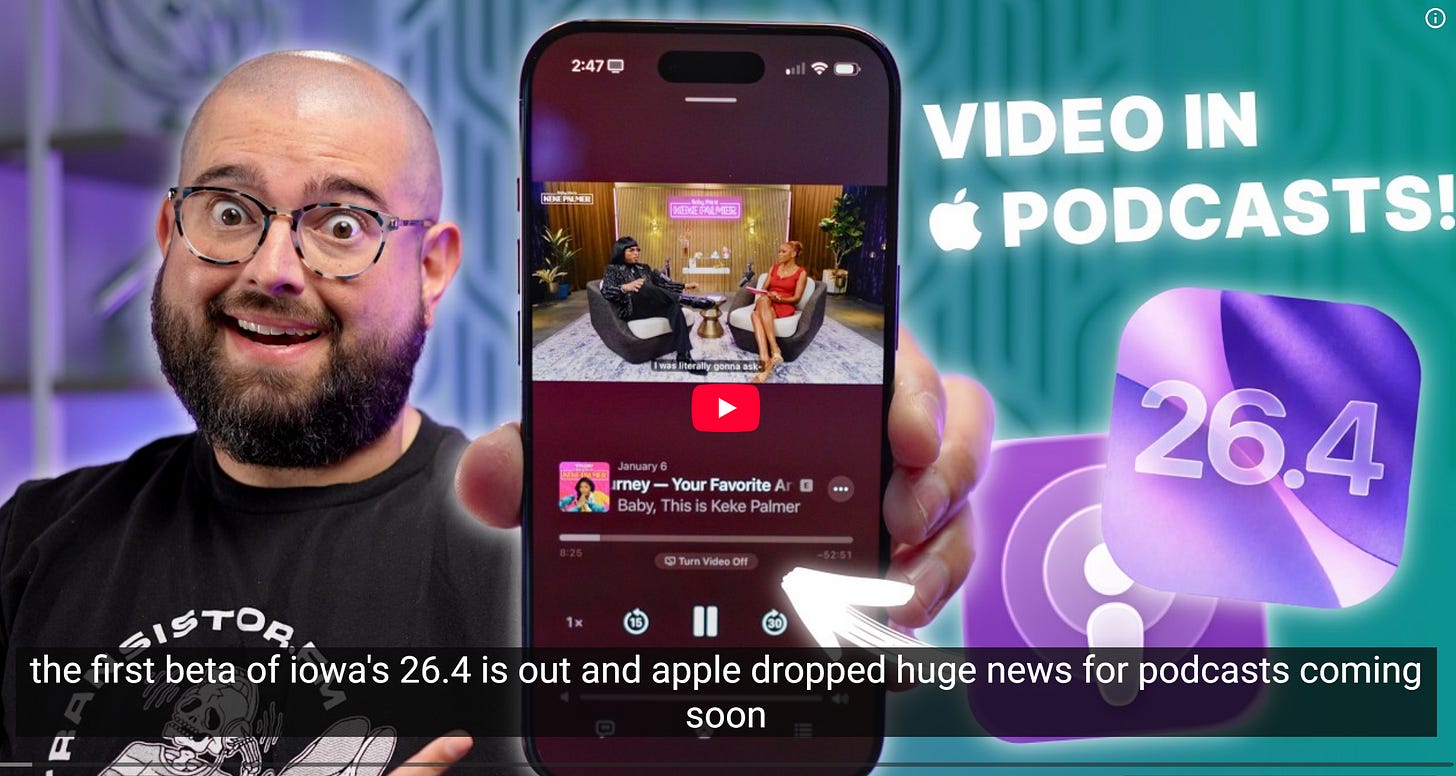
Podcast sage Stephen Robles has published a detailed walkthrough video.
He demonstrates:
How video appears inside the app
How switching between audio and video works
How playback behaves
But he also highlights something important:
There are still unanswered questions.
How are dynamic ads handled if a user switches from audio to video mid-roll?
Are impressions counted separately?
Will analytics clearly separate audio and video consumption?
How cleanly will transcripts, chapters, captions, and timed links integrate?
This is still in developer beta. Things may evolve before public launch.
How This Compares to Spotify and YouTube
Spotify and YouTube let anyone upload video for free, but the video lives on their servers. Advertising options are constrained by their systems unless you’re large enough to qualify for revenue programs.
Apple is taking a different approach:
Your host keeps the video
Your host controls ad insertion
Apple charges a delivery fee for dynamic ads
Distribution remains host-based
It’s less “upload to platform” and more “extend the podcast infrastructure into video.”
That distinction matters.
Is This Good?
I don’t know honestly. But it IS the future with HLS.
This changes what podcasting has always been built on: an open pipeline where any creator, on any host, can ship the same core experience to listeners everywhere. With HLS video, Apple is introducing a gated layer. Not for podcasting broadly, but for the version of podcasting that will increasingly look like the “premium” tier inside a major platform. That’s a foundation shift. It adds exclusivity to a medium that has mostly been allergic to it.
It also raises the stakes on production in a way creators should think about honestly. Video is a powerful discovery tool. It performs in search, it travels on social, and it helps new audiences decide in seconds whether they want to give you a chance. But discovery isn’t the same as consumption. In real client analytics, we consistently see people listen longer than they watch. Despite the headlines, most people don’t sit and watch talking heads for an hour. They sample video, then they live in audio.
So the opportunity here is real. Better video playback, better monetization mechanics, and a smoother “watch or listen” experience. But the risk is also real: creators feeling pressured to treat long-form video as the default, when long-form listening is still where podcasting wins. The smart move might be to treat video as the front door and audio as the living room. Build for both, but don’t confuse what drives discovery with what earns time.
In Other News, I’ve Got a Podcast Recommendation for You
If you haven't seen the movie "Don't Look Up," there’s an episode of Radio Davos with writer-director Adam McKay that’s worth your time regardless of how fervently you believe in climate change.
What makes the conversation compelling is McKay's insight that his film isn't really about the comet (or climate). It's about how completely we've broken our ability to talk to each other about any serious threat.
He makes a fascinating point about why so many people distrust experts and institutions now, and why that skepticism didn't come out of nowhere. It's one of those conversations that helps you think differently about why we can't seem to have productive debates about anything anymore.
Our Website Let's connect on LinkedIn Our YouTube channel The Stories and Strategies podcast on Apple, on Spotify And on YouTube