
New European Union Rules DO Apply to US Podcasts
The EU’s AI transparency rules are officially in force, and it doesn’t matter that your podcast is recorded in Toronto or New York. If a single EU listener can hit play, you’re in scope.
Article 50 requires disclosure any time AI generates or alters audio, video, or images in a way that could pass as real, what the law calls a deepfake. Production Expert’s breakdown of the rule draws the line clearly: routine repair work like de-noising, pitch correction, or dialogue cleanup doesn’t count. What counts is generating whole phrases or lines the speaker never actually said, even if you’re just patching a rough take.
Timing matters here too. Anything you published before this week is grandfathered in, so your back catalog needs no relabeling. Text is treated differently though. If AI assisted writing goes live on or after this week, the publish date decides it, not the draft date.
Practical takeaway: if you use AI voice tools anywhere your show reaches an EU audience, and an open RSS feed reaches everywhere, disclose it clearly the first time a listener could encounter it. A short spoken note at the top of the episode covers you. Production Expert has the fullest plain English rundown I’ve found on this, including what counts as artistic exemption and what the real penalty structure looks like:


And on a personal note… I think this is a very positive step in podcasting’s evolution.
Your Podcast Host - Trust Beats Fame
New Clutch research finds 59% of listeners feel a personal connection to the hosts they choose to listen to, and 62% say it doesn’t matter to them whether that host is a celebrity or a complete unknown. Put those two numbers together and you get the actual mechanism behind podcast influence. It isn’t reach. It isn’t star power. It’s the sensation of listening to a friend, someone whose voice you recognize, whose opinions you’ve tracked over dozens/hundreds of episodes, who feels like part of your week rather than a face on a screen.
That’s a different kind of trust than a billboard or a banner ad can buy, and it’s exactly why 42% of listeners have made a purchase off a host’s recommendation. Brands chasing reach keep hunting for bigger names. The smarter play is finding the host whose listeners already treat them like a friend, then staying out of the way of that relationship.
A few other findings worth flagging:
79% listen to at least one podcast a month, 48% listen more than they did a year ago
62% will give a podcast a shot purely because the topic interests them, ahead of any host loyalty
YouTube (30%) has nosed ahead of Spotify (27%) as the top platform, but 39% move between video and audio depending on the moment
61% would trust a host less after one promotion that feels off brand or fake
64% already know non media brands are producing their own podcasts
46% would reject an AI-hosted podcast
That last number is a bit concerning to me. Not the 46%… but the 54% who might be ok with an AI host.
Starting a Podcast Is Easy. Keeping One Going Rivals a January Gym Membership
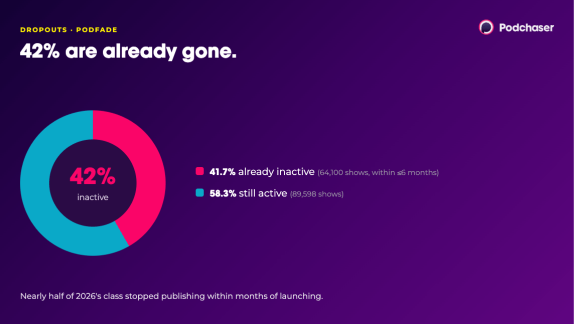
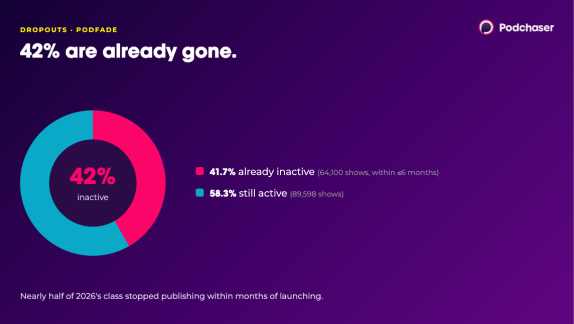
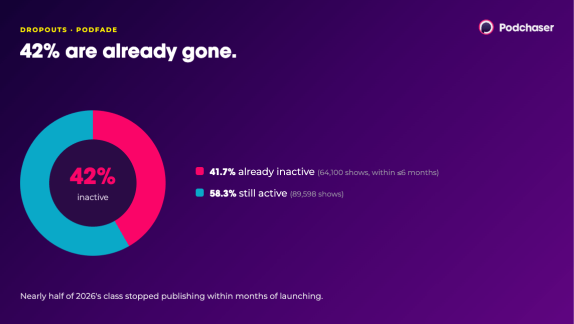
Podchaser pulled data on every podcast launched in the first half of 2026. All 153,767 of them. The numbers tell a story that won’t surprise anyone working in this industry, but the scale of it is still striking.
42% of those shows are already inactive. They launched, published a handful of episodes, and went quiet, all within months. Podfade. Podcast apps are full these Zombies.
Of the 58% still publishing, only 0.7% reached 13 reached a million listeners. 1,119 shows out of 153,767. Clearly for most podcasters it’s about your niche… not audience size.
There’s also a new variable distorting the raw numbers. At least 2.5% of new shows carry content-mill fingerprints, templated AI-generated audio cloned across dozens of cities and topics. Raw podcast counts now overstate human creative activity, which means the signal-to-noise problem is getting structurally worse.
Two findings worth noting for anyone thinking about the medium’s health. New podcast creation is now at its lowest point since before the pandemic, down 80% from the 2020 peak and 14% year over year. And listening is healthier than ever. Those two things are not in conflict. The gold-rush era of “everyone start a podcast” is over. The successful ones now (which again increasingly is about niche, not size) are purposeful and well-planned.
The benefits of podcasting for brands and individuals who commit to it remain well documented. Trust, authority, audience depth, and conversion rates that outperform most digital channels. The problem has never been whether podcasting works. It’s always been the gap between starting and staying and understanding you’re not going to be Joe Rogan.
The Case for Paying Attention to Your Episode Titles
ran a controlled experiment on her own finished podcast, rewriting all 92 episode titles for clarity rather than creativity, and monthly downloads jumped from 241 to 464 with no other changes. Her argument is straightforward: your title and your episode are doing two different jobs. The title gets the right listener to press play. The episode rewards them for doing it. In a world where podcast apps, Google, YouTube, and LLMs like ChatGPT and Claude are all reading your metadata to match your content to someone’s question, a clever title that obscures the topic is working against you.
Why Links in Your Show Notes May Not be Generating Much Action
Most branded podcasts still write show notes like a landing page. Link to the study, link to register for the masterclass, link to the thing you’re actually selling. Turns out almost nobody is clicking any of it, and it’s getting worse. When Google shows an AI summary above the search results, only 8% of people click through to a website at all, down from 15% when there’s no summary. Even a source link cited directly inside that summary gets clicked just 1% of the time. Those numbers come from Pew Research Center, tracking nearly 68,879 real searches through 2025.
argues in PR News this makes click through a bad way to judge whether a podcast placement worked, and a weak reason to build show notes around driving traffic. If almost nobody clicks through regardless of how good the placement is, all those links to your gated content and your product pages are doing less work every year. What still matters is whether an AI system reads your show notes as a real, quotable answer and cites your spokesperson when someone asks a related question. Answer engines can’t listen to audio. They read text, so an hour of great insight on the show stays invisible to them unless the notes actually spell it out in writing. His fix is five habits most shows skip:
Lead with the real question a listener would ask, not the episode number
Publish the full transcript instead of a teaser, since Apple made transcripts native in its app back in 2024
Name the guest, company, and specific figures instead of writing a vague recap
Link episodes to each other so search systems read your show as a body of expertise
Write each key point so it stands alone, since a machine quotes one sentence at a time
If you’re producing a branded podcast to sell something through the show notes, this is your evidence that strategy needs a rethink.
Jordan Harbinger Compared YouTube to Audio Podcasts
Jordan Harbinger makes an observation that cuts to the heart of what makes audio different.
YouTube, he says, runs on alarmism. Shocked faces, red arrows, titles that suggest civilization ends this Tuesday. Nuance doesn’t get clicks. Panic does.
Audio is a different contract. He can make an episode about sand, actual sand, and because it’s already on your phone and you’re already driving or walking the dog, you listen. You’re not choosing between him and MrBeast and a thumbnail promising the end of humanity. You’re just listening to the next thing from someone you already trust.
His conclusion: “Not pandering to the algorithm is why my show hasn’t become the Jerry Springer of podcasts.”
Other Stuff
These are the top podcast networks based on reach
If you want to go deeper than the very tippy top of understanding podcast networks by reach dig into ’s Podcast Network Insights. Soooo much more to understand