

How We’re Using Chat GPT (and what that means for your podcast)
Chat GPT released usage data and only 1/3 of usage is work-related. For the most part we’re using it for “practical guidance.”
And okay, this isn’t directly about podcasting BUT… there’s a big lesson here for creators. If people are increasingly turning to LLMs for practical guidance, we need to think carefully about what makes a podcast worth listening to.
“Five things in your kitchen that could poison you” is a question for an LLM.
“I invited a poison expert into my kitchen to see what they’d find” is a podcast episode.
The first delivers information. The second delivers an experience.
And that’s the distinction podcasters need to understand. If your episode can be reduced to a handful of bullet points without losing much of its value, you’re competing with a technology that can deliver those points in seconds.
But curiosity, surprise, chemistry, tension, humour, and the unexpected? Those are reasons to listen.
Offer what AI can’t replicate. AI can summarize information in seconds. Your advantage is lived experience, original reporting, personal stories, and genuine human connection
Rethink who you’re competing with. It’s not just other podcasts, YouTube, or social media anymore. AI is becoming another destination for people’s curiosity and attention
The takeaway? If you look at the chart and think “Oh ok people want answers to things, I’m gonna make episodes about that,” you’re missing what I’m saying. The LLM is going to scrape your transcript and short circuit you. Don’t just give people information they can extract. Give them an experience they can’t. Create podcasts people turn to for answers, but stay for the human experience and perspective.
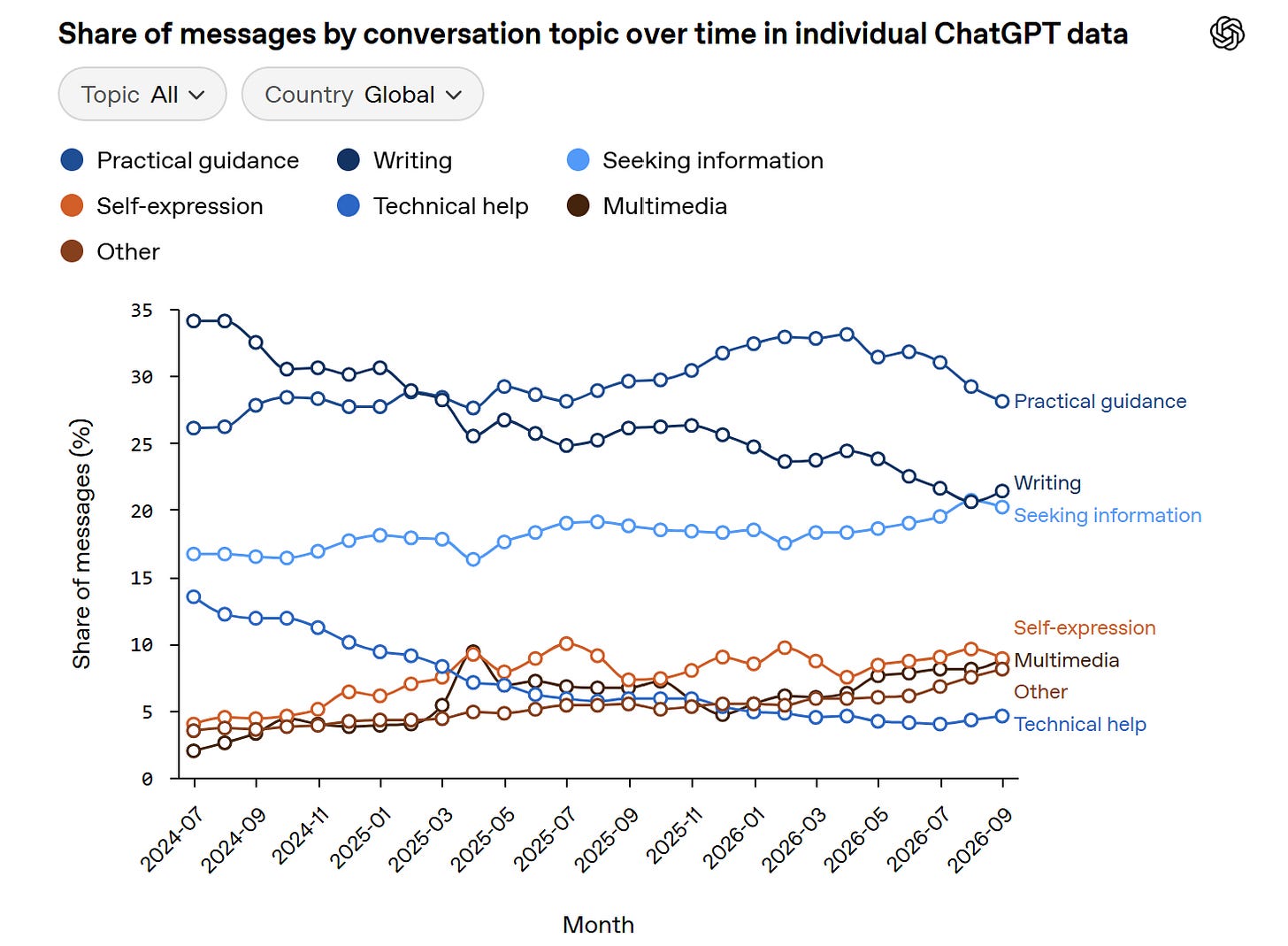
Here’s a simple question to ask of each episode you do… If someone asked ChatGPT to summarize this episode, what would it miss?
Thanks to the inimitable at BuzzStream for flagging the Chat GPT report.
Audio Is Becoming a Habit
We’re listening to audio more.
A new eMarketer analysis of Airship data finds monthly app sessions per active user in the music and audio category rose 10.7% in North America in Q3, from 25.2 to 27.9. Finance, health and fitness, lifestyle and shopping apps saw flat or negative growth over the same stretch.
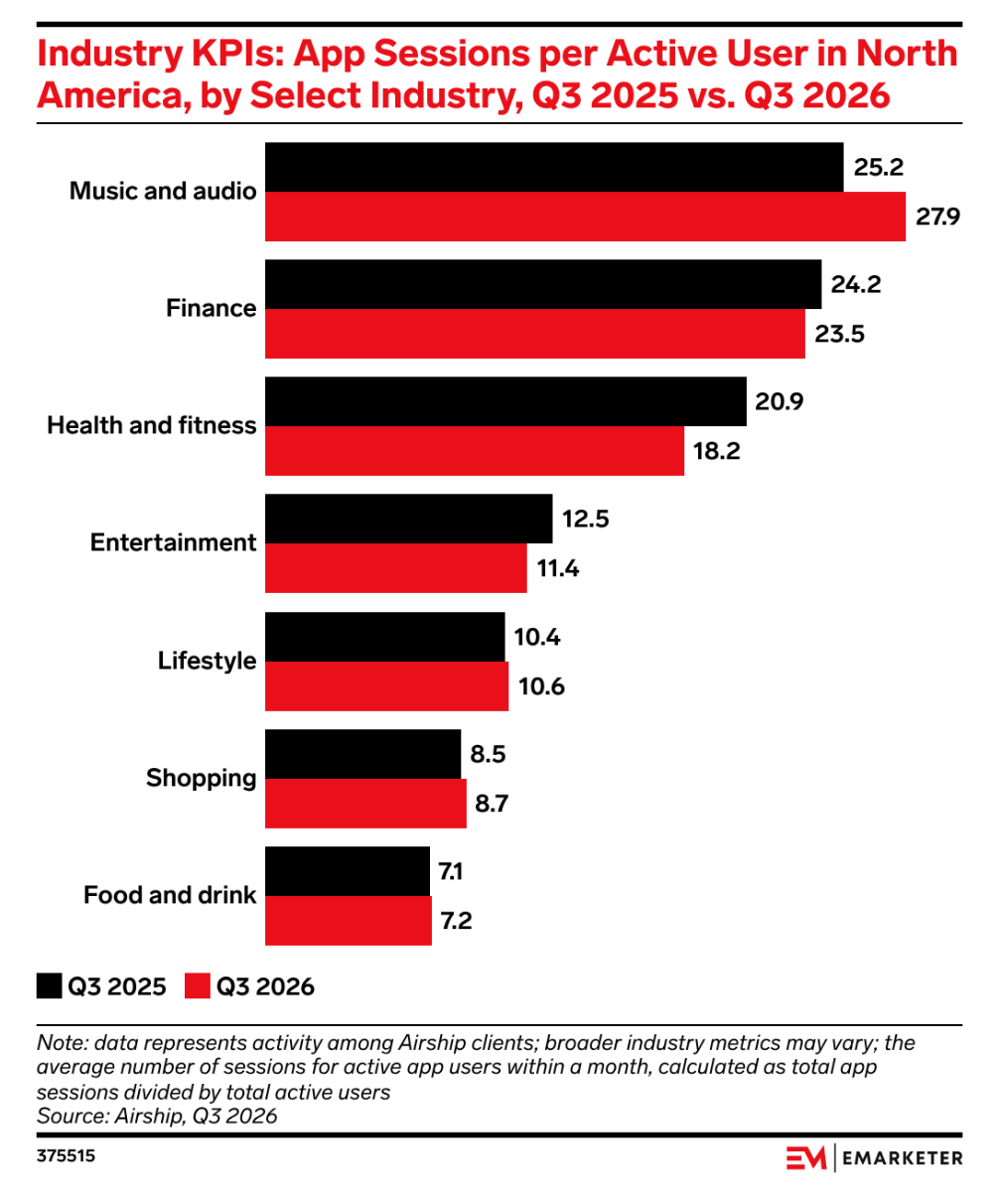
The study can’t tell us two things. The category bundles music and podcasts, so we don’t know how much of the lift is podcasts vs music. And a session is an open, not a listen, so we don’t know whether anyone is spending more time.
What it does show is choice. Think about what those other apps are. Finance, health, lifestyle and shopping are task apps. You open them because a bill is due, a workout needs logging or something needs buying. Audio is a habit app. Nobody has to open it, so every session is a decision. Flat task apps probably mean our errands didn’t change, while a rising audio app means more people chose it.
So what’s it being chosen over? My guess is the social media scroll. The closest evidence I found is MRI Simmons’ October 2025 podcast study, cited in an Audacy analysis, where 39% of weekly podcast listeners said podcasts replace social media scrolling. Another 36% said live TV and 34% said streaming music. That’s self reported, it only covers people who already listen to podcasts, and it’s a different dataset from Airship’s. It’s a clue, not proof.
YouTube May Soon Decide Which of Your Ad Reads Are Ads
YouTube is rolling out automated detection for branded content. And if its systems decide a newly uploaded video contains branded content you didn’t disclose, it will apply the disclosure label on your behalf.
Most of the coverage will focus on the other changes. The old “Includes paid promotion” tag gets a fresher look, the policy now says “branded content” instead of “paid product placement,” and creators who declare a sponsorship get new age and location controls. Those are useful, especially if a brand deal comes with regional restrictions. YouTube even says you won’t have to pass on a partnership because of them.
But look at how the pieces fit. The controls only unlock if you declare the sponsorship yourself. The detection kicks in when you don’t. One is a reward for volunteering, the other is a net under everyone who doesn’t.
Noticeably, the announcement doesn’t say what signals the system reads, whether that’s the audio, the description, a spoken sponsor mention, or something else. It doesn’t mention podcasts at all. I’d be careful about assuming a host read ad in a video episode gets flagged. But I’d also be careful about assuming it won’t, because a conversational sponsor read is the least obvious kind of branded content for any system to classify, and that’s exactly the kind we make.
There’s a practical problem here too. A label you didn’t choose, appearing on an episode your sponsor approved, is a conversation you don’t want to have after the fact. And YouTube is clear, responsibility stays with you regardless of what its systems catch or miss.
So my advice is simple. If an episode has a paid read, declare it at upload, and use the new controls to match whatever your sponsor contract requires. Tell your advertisers now that this is coming, before a label shows up unannounced.
Your Origin Story Could Be Someone’s Comfort Listen
Stars of Scrubs, The Office, and Boy Meets World, all successful shows, are now going back through their old shows on podcasts. Disney has a similar model for franchises like The Mandalorian and Grogu. Take successful shows or movies and extend their life by creating podcasts based on them.
Stephen Battaglio at the LA Times reports the genre has become a staple. iHeart’s podcast president says Fake Doctors, Real Friends has passed 100 million downloads and helped spark the Scrubs reboot.
But your brand is smaller. You aren’t Disney or big Hollywood brand so you can’t do this right? I think you can, once you see why people listen. They aren’t looking for something new. They want more time inside something they already love, with the people who made it. Kate Rose of Audacy says fans replay episodes because it’s a “comfort listen.”
Here’s how I’d translate that for a small or mid-sized brand. You don’t need 292 episodes of television. You need a story your best customers already care about and the people who lived it. Think of a founder and first employee revisiting how the first product got made, or a team working through ten years of customer projects, one a week. Start where the attention already is, with customers, alumni and long time fans, not strangers.
Your audience will be smaller, so judge it by who shows up and whether they come back, not by downloads.
It’s a Podcast Tool… No it’s a Newsletter Tool… No Wait…
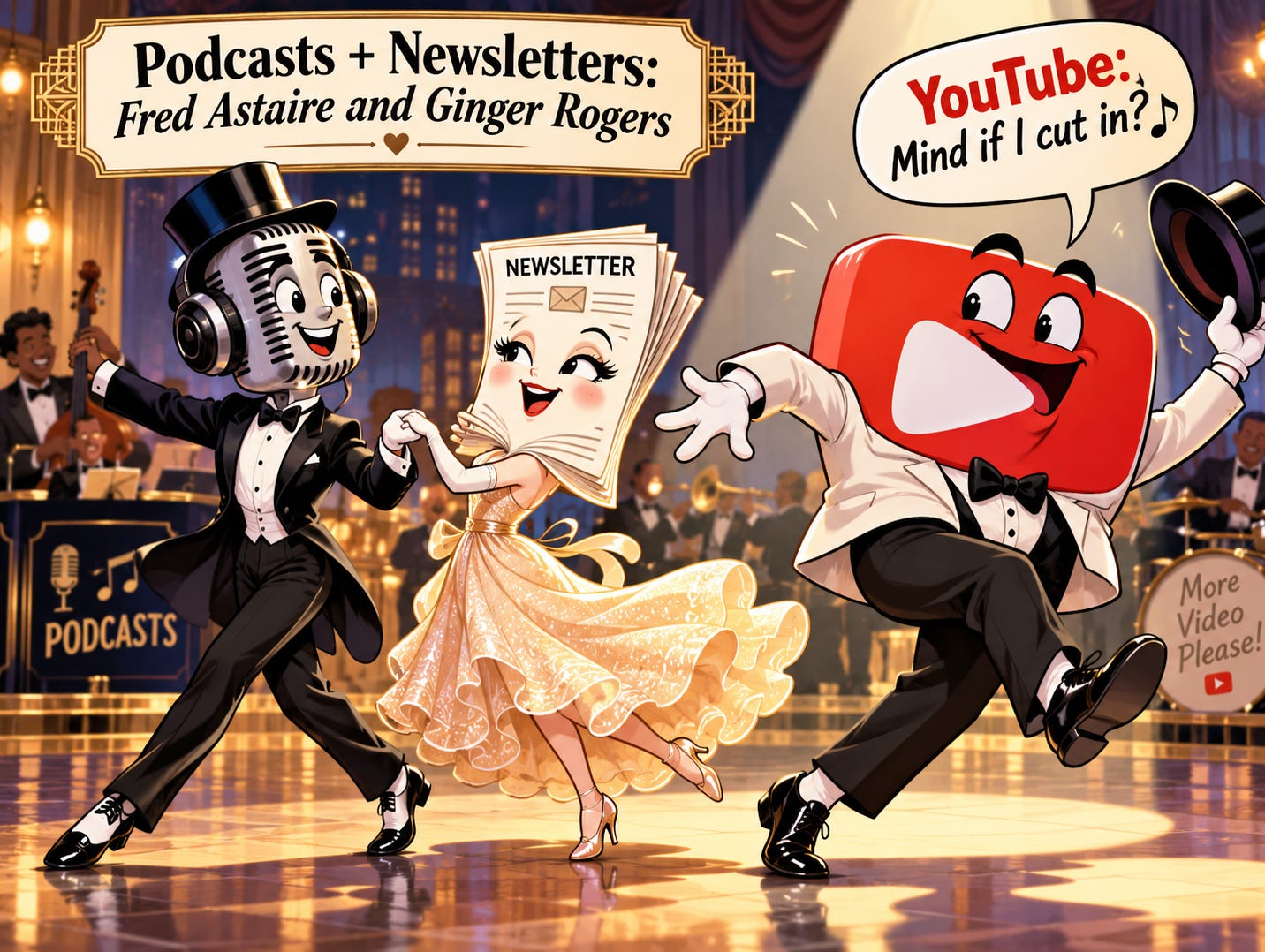
Substack and Beehiiv are adding podcast membership tools, and now Supercast is moving the other way. It’s launched a newsletter feature as part of its base toolset, with content gating, tiered subscription levels, and segment targeting. This is all just cementing the idea that podcasts and newsletters really are Fred Astaire and Ginger Rogers… perhaps with YouTube cutting in mid-song.
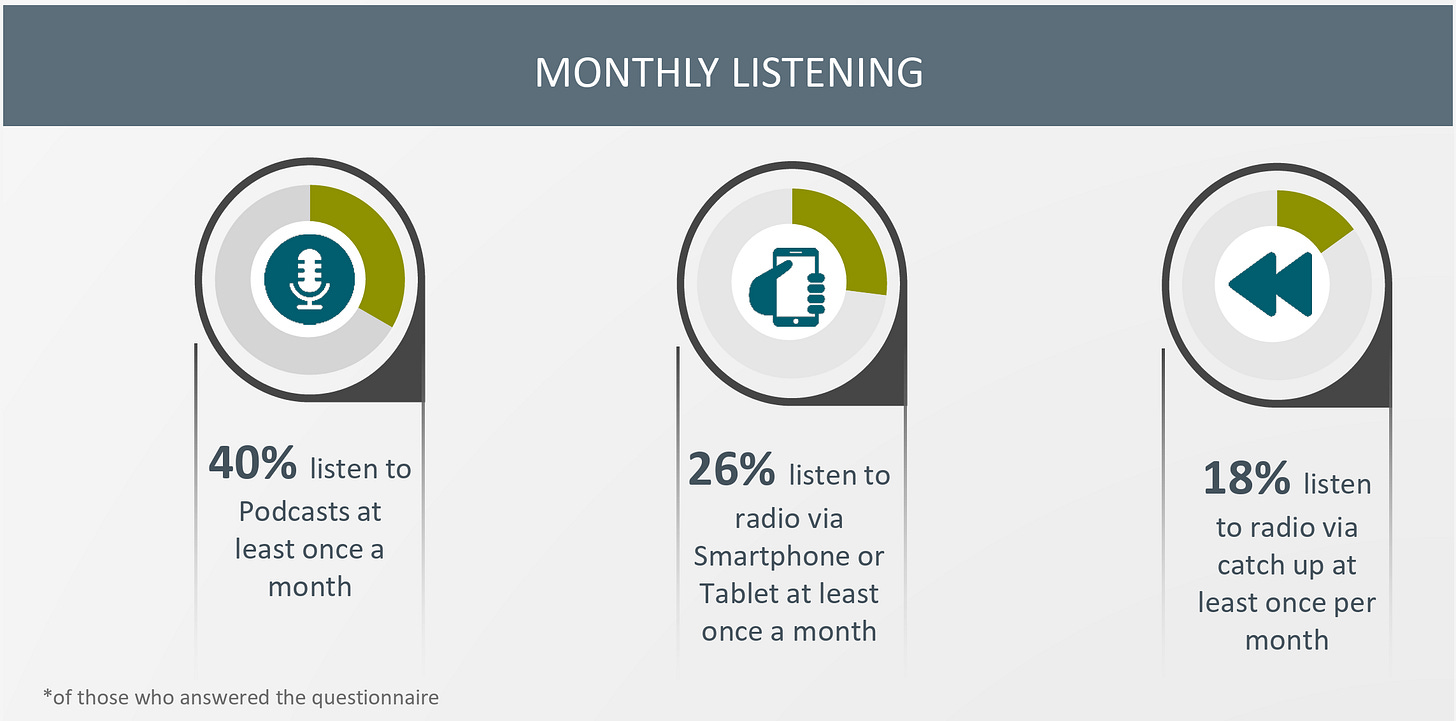
40% of Brits Listen to Podcasts at Least Once per Month
That’s according to Rajar’s Q3 2026 Report
Other Stuff
As podcasters become cultural juggernauts, brands should tune in says Vogue