
I’ve been sitting with four studies this week that, taken separately, each tell a clean story. Taken together, they’re considerably messier.
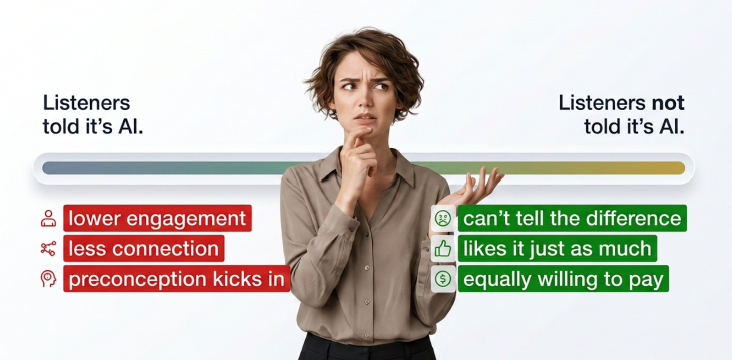
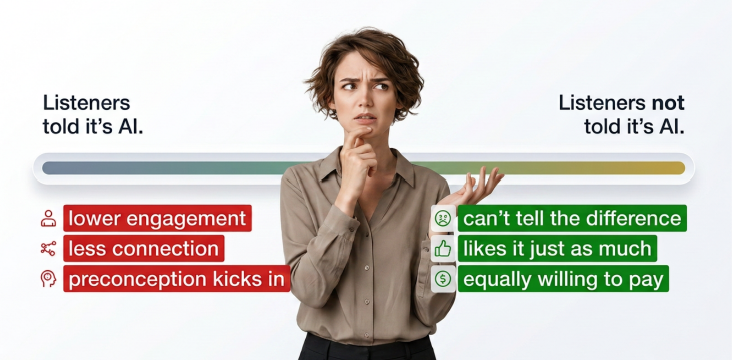
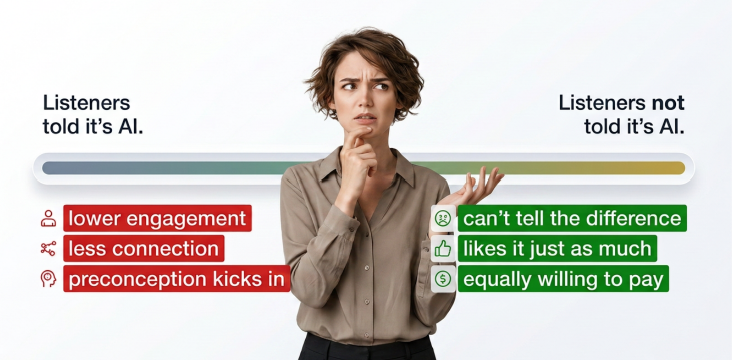
The first says AI-labeled content gets meaningfully less engagement. People feel less connected to it. The behavioral science behind that finding is solid.
Alright so AI is bad! But wait…
The next two studies say listeners can’t actually tell AI from human, whether in audiobook narration or audio advertising. And when they hear AI done well, they like it just as much, sometimes more, and they’re equally willing to pay for it.
So which is it? Does AI labeling hurt engagement because people genuinely value human effort? Or does it hurt engagement simply because of preconceptions that dissolve the moment they actually hear the thing?
I think it’s both. The resistance to AI in audio is largely theoretical. It lives in the survey response, not in the listening experience. But the moment you tell people something was made with AI, the preconception kicks in and the connection drops. That’s not a contradiction, that’s a very human response to a question the industry hasn’t figured out how to answer yet.
The 4th study steps back from all of it and asks something more practical: when AI talks about your podcast, does it actually send anyone your way? Mostly no, and the fix has nothing to do with AI at all.
Here’s what I found…
AI-Generated TikToks Get Less Engagement. Should It Come With a Warning Label?
New research from the University of Southern California, published in the Journal of Consumer Research, analyzed 8 experiments and over a million TikTok posts and found that when content is labeled “made with AI,” engagement drops measurably. Posts received 7%-8% fewer likes, combined engagement fell 7%, and people felt 14.5% less connected to the creator, even when the quality of the content was identical.
The behavioral science behind it is straightforward. We value things we believe took effort to make. AI signals low effort, and low effort signals low connection.
The study didn’t examine podcasts specifically, so we can’t say the numbers would be the same for audio. But the direction of the finding is hard to dismiss in a medium where trust and intimacy are the product.
Which raises a question worth sitting with. AI-generated podcast episodes are increasingly common and often indistinguishable from human-produced ones. Maybe the answer isn’t to ban them or condemn them, but to require what we require on cigarette packages: clear, honest labeling. Not to shame the creator, but to let the listener decide.
Turns Out Audiobook Listeners Don’t Mind AI Narration. They Just Had to Hear It First
Keep that labeling thought in mind, because the next three studies complicate it considerably.
Edison Research at SSRS ran a blinded study of over 1,000 U.S. fiction audiobook listeners for Spoken, an AI audiobook company. Half heard a professional human narrator reading a sci-fi thriller. Half heard AI multi-cast narration with distinct voices for each character. Neither group knew which was which.
The results challenge most assumptions about AI voice acceptance in audiobooks:
Before hearing anything, 31% said they’d likely listen to an AI audiobook. After hearing the Spoken version, that jumped to 65%, more than double
61% of those who heard the AI version thought it was human. 65% thought the human version was human. Listeners genuinely couldn’t tell the difference
AI multi-cast outperformed human narration on favorability (61% vs. 53%), perceived quality (66% vs. 60%), and engagement (58% vs. 49%) for character-driven scenes. Human narration won on exposition without dialogue
Purchase intent was statistically identical: 46% for AI narration, 49% for human
Audiobooks and podcasts aren't the same medium. But they share a listener, and that listener is apparently more open to AI than the labeling study would suggest. The key variable may be whether they know going in.
AI Voices in Audio Ads Are Now Essentially Indistinguishable From Human. And Sometimes Better
New research from Azerion and Differentology tested 3,000 UK listeners on audio ads voiced by humans versus AI. The headline finding pairs well with the audiobook study above: most people can’t tell the difference, and their assumptions about which would perform better were wrong.
Key findings:
Overall brand uplift was identical at 3% whether the ad used a human or AI voice. But AI ads were rated more distinctive, more attention-grabbing, and more likely to give listeners a reason to choose the brand
37% of listeners thought the AI-voiced ad was human. Only 29% correctly identified it as AI. Meanwhile 26% thought the human voice was AI. Nobody really knows anymore
The regional accent finding is the most striking. When AI voices were matched to the listener’s local accent, 33% said they’d recommend the brand, compared to 10% for the neutral human version. Brand uplift jumped from 3% to 9%
39% of respondents going in believed human-read ads would be more effective. The data said otherwise
The practical note for podcasters who run host-read ads: your voice, your relationship with your audience, and your authentic delivery still matter. But the gap between human and AI in audio advertising is closing faster than most assumed.
When AI Mentions Your Podcast, it Doesn’t Always Link to it. Here’s why that Matters
One more AI finding, this one less about voice and more about visibility.
BuzzStream analyzed 12,000 AI responses across Google AI Mode, Google AI Overview, Gemini, and ChatGPT to understand how AI mentions and cites brands. The findings have direct implications for anyone building authority through podcasting.
The key findings:
Only 23% of brand mentions in AI responses include a citation link. AI names your podcast or brand far more often than it actually links to your content.
When AI does cite a source, 70% of the time it also names the brand. Citations and mentions are two different signals and should be tracked separately.
ChatGPT is more likely to cite and name a brand in the same response (28%) than Google’s AI products (around 22%). But Google AI Mode cites an average of 33 URLs per response versus ChatGPT’s 3.8, which explains much of the gap.
When someone searches for a specific brand by name, 39% of mentions are backed by a citation. When someone searches a category like “best podcasts about business,” that drops to just 7.2%.
80% of AI citations come from earned media on third-party sites, not the brand’s own content. Getting covered elsewhere is what gets you cited.
The practical takeaway: if you want AI to not just mention your podcast but actually point people toward it, earned media coverage matters more than your own website. Guest appearances, press mentions, and third-party features are feeding AI’s citation behavior in ways your own show notes never will.
Why Podcast Analytics are Still the Wild West
IAB Tech Lab just released version 2.3 of the Podcast Technical Measurement Guidelines for public comment, open through August 21st. Always meaningful, always helpful. The working group is trying to bring consistency to an industry that’s mostly been counting on vibes for a decade.
But digging into the details kinda shows we’re in the pioneering days of podcasting.
Take IP hopping. Your host identifies a listener by matching IP address plus user agent. Listening on your phone during a commute and your carrier bumps you to a new IP mid episode? The system sees a brand new listener. Same person, same episode, counted as two downloads. And it cuts both ways since old IPs get recycled to new people too, quietly merging two real listeners into one. The industry bet is these errors cancel out over a big audience.
Then this is something I’ve seen specifically in Apple Podcasts showing 12 plays for an episode but zero listeners. Huh? Downloads and listeners get calculated with separate logic, so they’re never actually required to match.
And… if you change your episode URL, even something as small as adding a hosting prefix, some podcast apps read that as a brand new episode and quietly re-download it. Same content, same episode, but now it’s double counted, and if you change the URL again later, it can trigger yet another re-download. The document’s fix is refreshingly blunt: don’t touch your episode GUID, ever, if you can help it.
None of this means your numbers are fake. It means every download report you’ve gotten is an estimate wearing a very confident font. That’s exactly why it matters to have someone in your corner who actually understands this industry and can make sense of your numbers with you.
Audio Is the Foundation. But Who’s Listening Versus Watching Tells a Very Different Story
Nielsen’s summer 2026 Podcast Listener and Viewer Report confirms what the loudest voices in the industry sometimes obscure: audio remains the overwhelming foundation of podcast consumption. 90% of monthly podcast consumers choose to listen. Across the top 10 genres, more than 96% are listening at any given time. Only 2% watch exclusively. And podcasts now account for 20% of all daily ad-supported audio time among American adults, behind radio at 62% but well ahead of streaming audio at 16%.
But the more useful section of the report is not about format share. It’s about who these people are and how differently they behave.
Nielsen profiles two distinct consumers. The pragmatic listener treats audio as a secondary soundtrack: married, highly educated, employed full-time, consuming 10.2 shows weekly across commutes and workouts, highly responsive to direct-response calls to action. 46% look up a website after hearing a product mentioned. 25% make a purchase.
The interactive watcher treats the podcast as a destination. Younger, more likely to be a student, seated at home, giving the screen their full attention. They convert at a slightly higher direct purchase rate (29% vs. 25%) but their real value is amplification: they’re far more likely to follow a brand on social media or visit a physical storefront after exposure.
The format a listener chooses tells you more about their mindset and their path to purchase than almost any other variable. Audio reaches people in motion. Video reaches people at rest. Both convert. They just convert differently
Other Stuff
Empowered Podcasting Conference · Aug 21 · Charlotte, North Carolina, USA
Podcast Movement NYC 2026 · Sep 17 · New York, New York, USA
Cool Tool: PodcastPilot
A new Mac app from Danish studio builder Video People that records multicam video podcasts and hands your editor a fully synced, organized timeline for Premiere, Resolve or Final Cut, cutting out that first hour of post.