
How the Dems Used Smaller Podcasts as the Road to Success
Democrats took the Senate last night and by the time I went to bed, it looked like they would take the House as well.
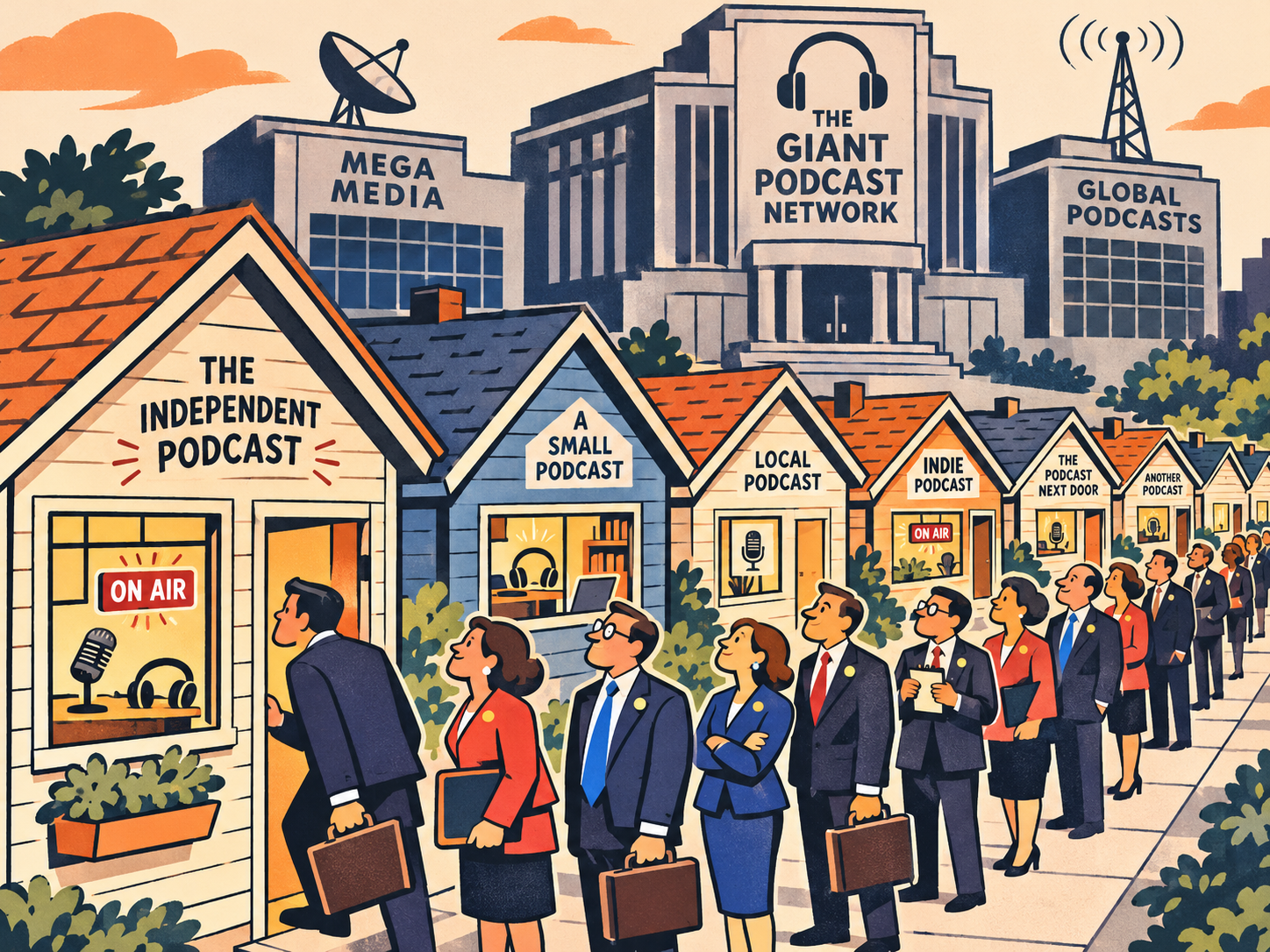
Once again podcasts played a strong role in the election campaign. But this time, instead of the big shows (Rogan, Shapiro, Pod Save America) having big impact, you know what? The data actually points to the smaller shows being the prime targets in the 2026 campaigns.
Rephonic did an extensive study showing how the parties approached things strategically and the smaller shows got big attention.
The parties did work the dial differently. Democrats spread out, while Republicans leaned on a handful of big shows. GOP five biggest podcasts accounted for 55% of their share of voice, against 40% for Democrats.
The BIG news is candidates on both sides treated small podcasts as real campaign stops. Rephonic cites the Sounds Profitable survey saying one in four likely voters who listen to podcasts say an appearance could make them more likely to vote for that candidate. “Could” is a soft word, but campaigns clearly felt the time was worth spending.
If you host a small show, the pitch is coming. Decide now whether you take political guests at all, whether you’d offer equal access to the other side, and how you’d disclose it to your audience.
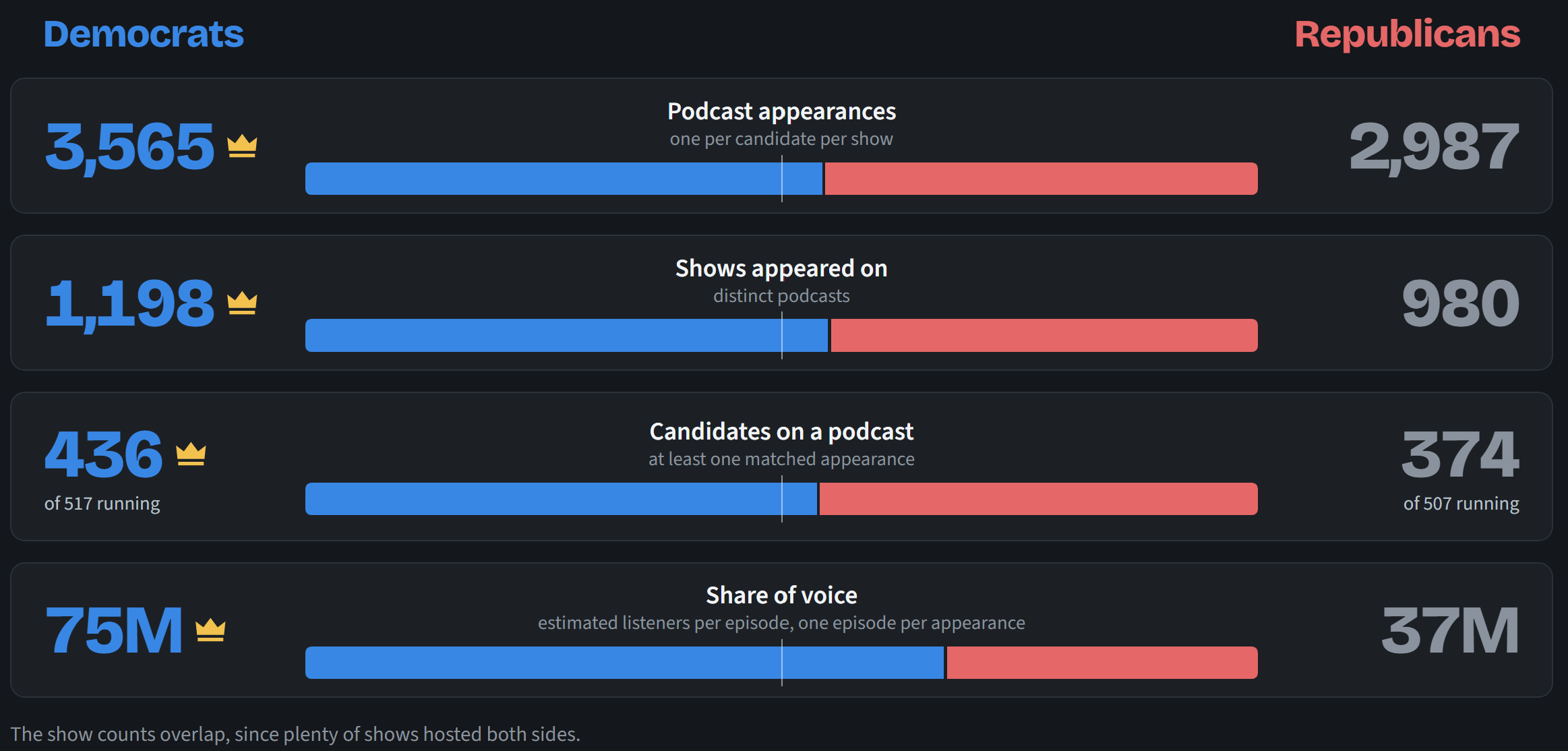
Image by Rephonic
Podcast Listening Reduces Brand Churn
People find your brand, they choose to follow, they may even love it, but eventually they stop paying attention to it. That’s churn and it’s inevitable if you don’t periodically refresh your brand. That’s marketing 101.
There’s a new study that suggests, if people are listening to your brand on a podcast, they are less likely to churn. Supporting Cast studied paid publisher memberships, not free podcast subscribers, and that distinction matters. Publishers like Slate and Vox sell a membership: people pay each month and get a bundle of articles, newsletters, ad free shows, and bonus podcast episodes. Supporting Cast delivers the private podcast part. A member gets a personal feed link to an episode, pastes it into their podcast app, and the members only episodes appear there.
Churn in this study means cancelling the whole membership, not just quitting a podcast.
Members who had ever downloaded an episode from that private feed cancelled at 1.3 percent a month, versus 3 percent for members who had access but never downloaded. Out of 1,000 members, about 145 listeners would cancel in a year, versus about 350 non-listeners.
That doesn’t prove listening alone keeps people but for a brand with a YouTube channel, newsletter, and blog, the lesson still holds. A podcast helps keep people’s attention.
And for publishers and creators, the practical takeaway is this: when paid audio is easy to find and use, members are more likely to get value from what they already pay for, and that can make a subscription business stronger.
A subscriber is a sign up. A listener is a relationship.
Is Podcasting Stalling? Tom Webster Says You’re Looking at the Wrong Numbers.
Podcast listening has plateaued. YouTube is changing the game. And most podcast listeners only have two or three shows they truly follow. So, is there still room for your brand’s podcast? Absolutely! But the opportunity may not be where you think it is.
I sat down with Tom Webster, one of the industry’s leading audience researchers at Sounds Profitable, to unpack The Podcast Landscape 2026. What he revealed should change how brands think about podcasting, from where their shows live to how they measure success. One of the biggest surprises? Despite flat overall listening numbers, 34% of people who have ever consumed a podcast started within the past year. There’s a lot more movement beneath the surface than the headlines suggest.
But perhaps Tom’s most valuable insight is that branded podcasts aren’t necessarily built to attract the masses. They’re built to turn awareness into preference. That’s a fundamental shift in how we should think about the role of podcasting in marketing. A few more gems from our conversation:
Podcasts shine in the middle of the marketing funnel. Advertising creates awareness, but podcasts build trust, deepen relationships, and move consumers toward choosing your brand
Habit is your competitive moat. The goal isn’t just to earn a listen. It’s to become one of the two or three shows people actively follow and return to
Stop obsessing over downloads. Measure whether listeners are more likely to consider, recommend, or engage with your brand
YouTube vs. audio is the wrong debate. People watch when they can and listen when they can’t. Meet your audience wherever they are
A smaller audience can deliver bigger business results. Reaching the right people and changing their minds can be far more valuable than chasing thousands of passive impressions
If your organization has a podcast, or you’re thinking about launching one, this is a conversation worth watching. Tom challenges some of the industry’s biggest assumptions and offers a smarter way to think about what podcast success actually looks like.
What Day/What Time Should You Publish New Episodes?
Everyone has an opinion on the best day to release a podcast. Almost nobody has the one number that would settle it. To tl:dr… you publish whenever you feel is the right time for your podcast.
Here’s the rest… Podchaser just counted 2.9 million episodes released from April to September 2026, and the pattern is lopsided.
85% come out Monday to Friday
Tuesday is the busiest day at 17.9% of the week, which means a lot of us are being clever in exactly the same way
Saturday is the quietest at 6.9%
Friday is the least crowded weekday in 18 of 19 categories
59% of weekly shows publish on the same weekday at least 80% of the time
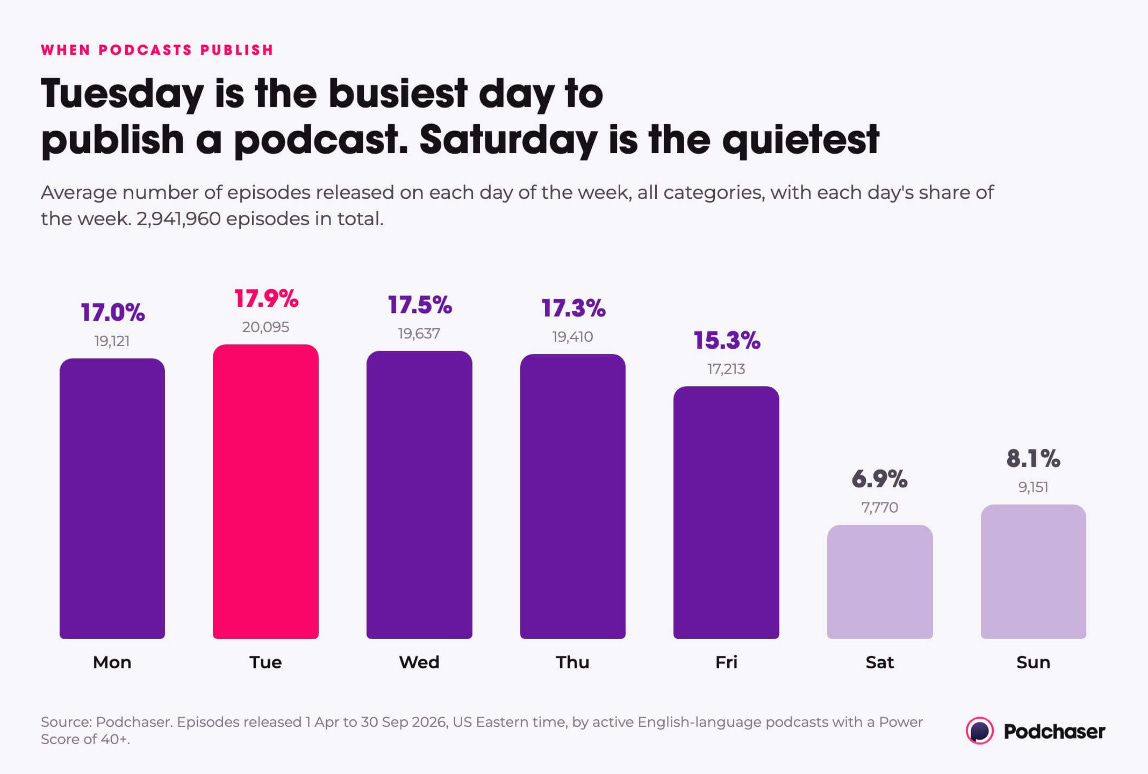
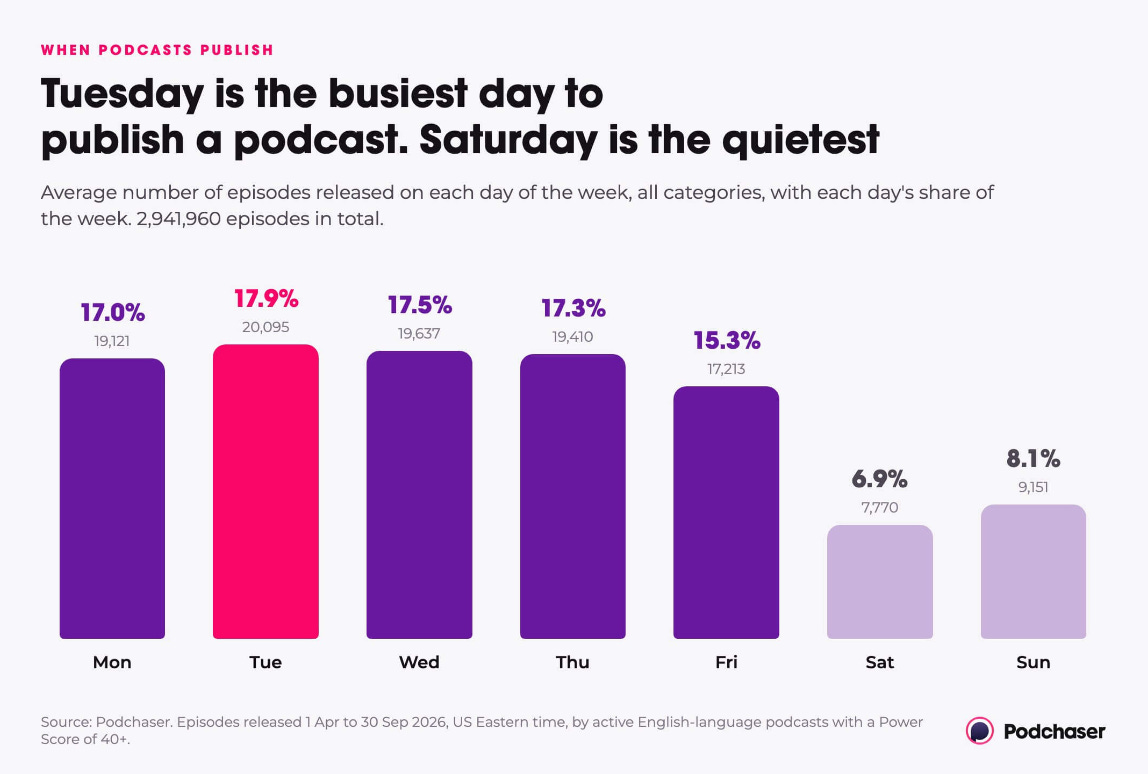
Here’s what catches my attention. Those figures show when shows publish, not when people listen.
I went looking for the other half and can’t find a recent, clean number for which days people actually listen. What exists is mostly download logs. Triton Digital’s 2024 Australian report, built on server logs, has Thursday on top at 16.9% of the week and the weekend days at roughly 9 to 10% each. Just because a download happened on Wednesday doesn’t mean anyone listened that same day.
Spotify’s 2023 Fan Study, drawn from its own platform, finds that 78% of consumption happens Monday to Friday, with weekday spikes at 8am and 5pm and a weekend spike between 11am and noon.
So both of these suggest weekdays win although not by a whole lot.
Time of day is better evidence. Edison Research’s Share of Ear data, released in October 2025:
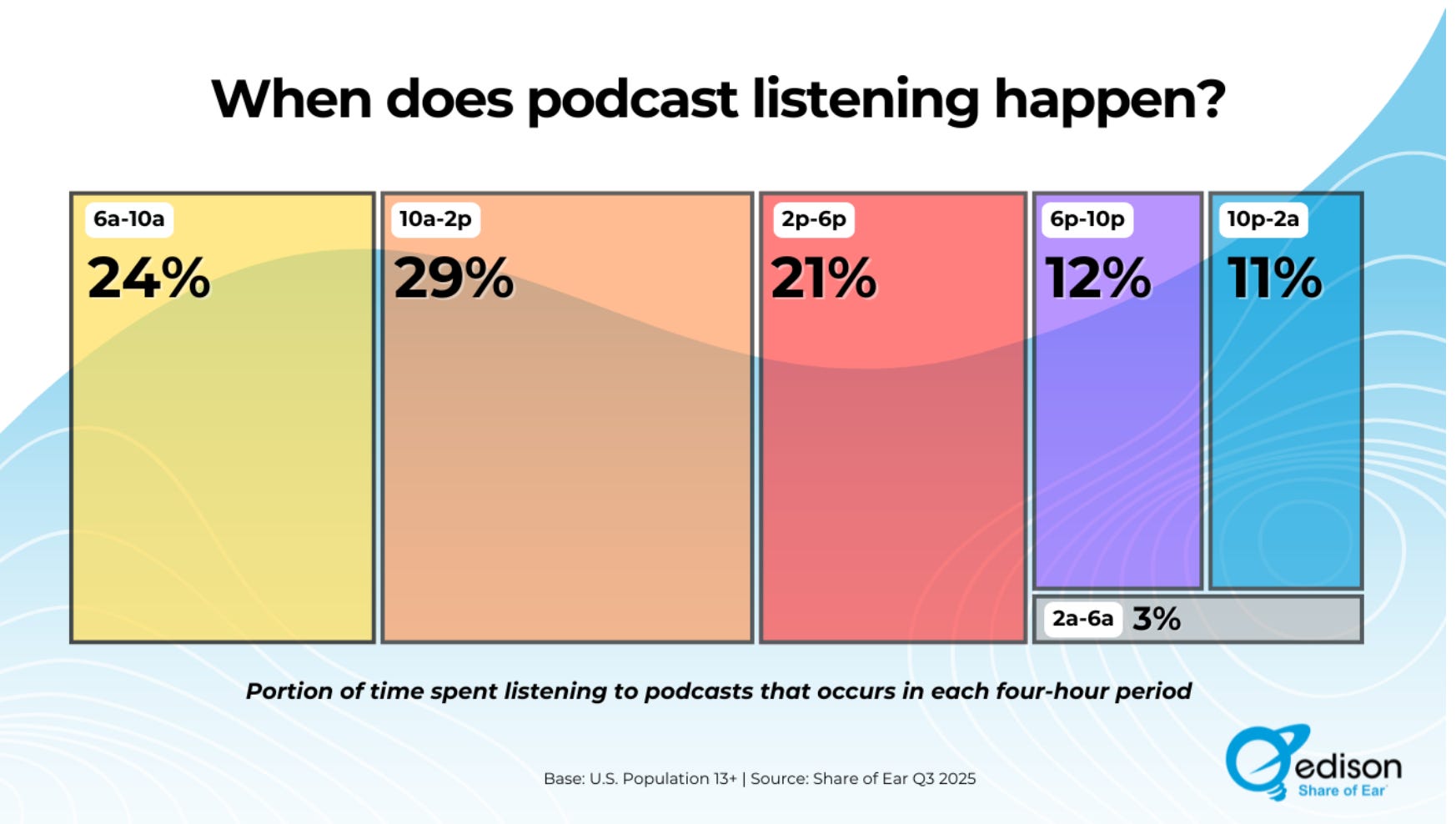
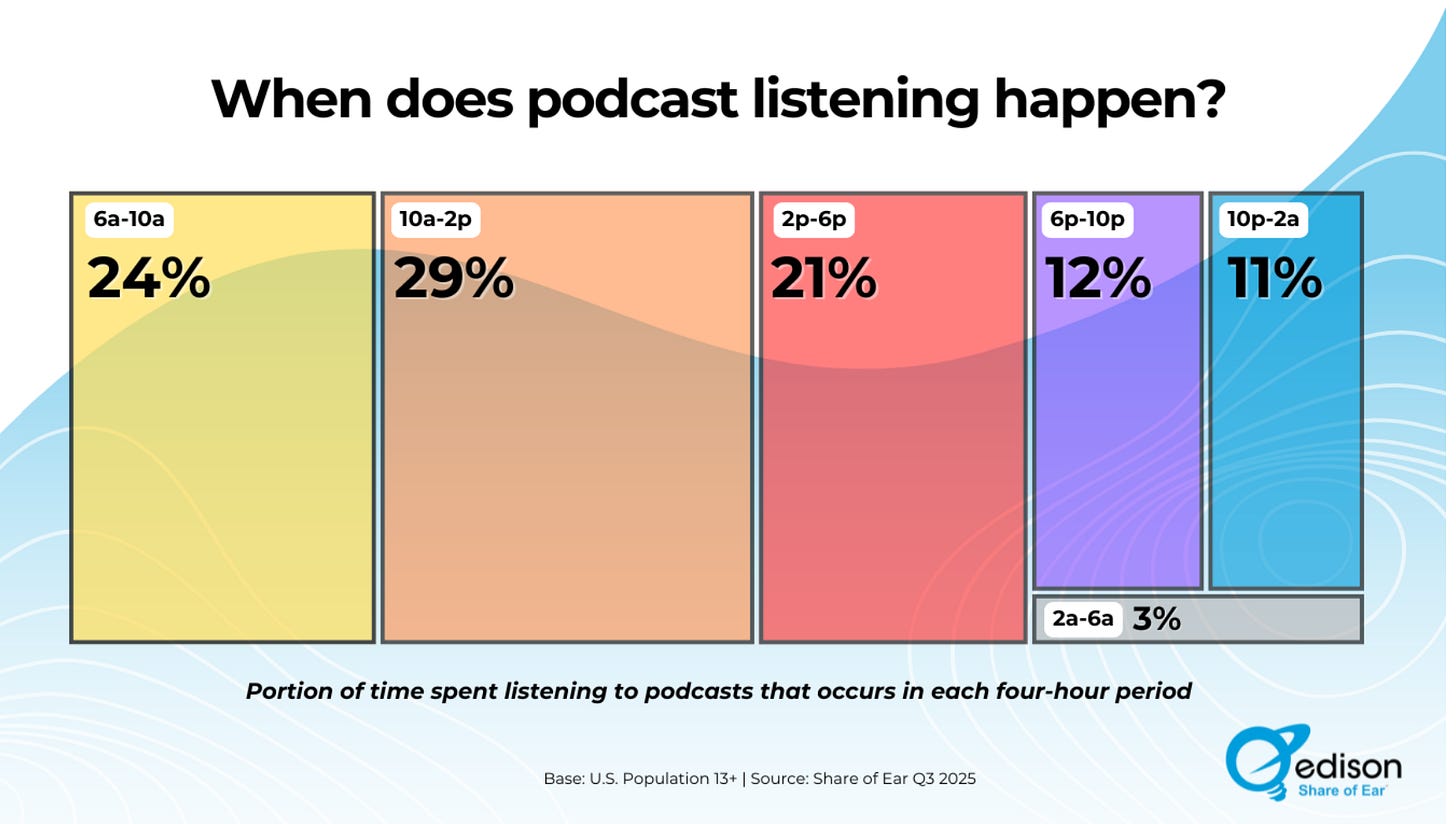
Podchaser finds that 44% of top shows usually publish between midnight and 6am Eastern. Big shows publish overnight so the episode is waiting, not because anyone’s listening then.
Genre matters more. Fiction, History, and True Crime put a fifth or more of their episodes out on weekends, while Business, Comedy, and Sports put out about a tenth.
For you, that means pick a day and keep it.
Podchaser’s full report breaks out all 19 categories, and it’s free with no sign up.
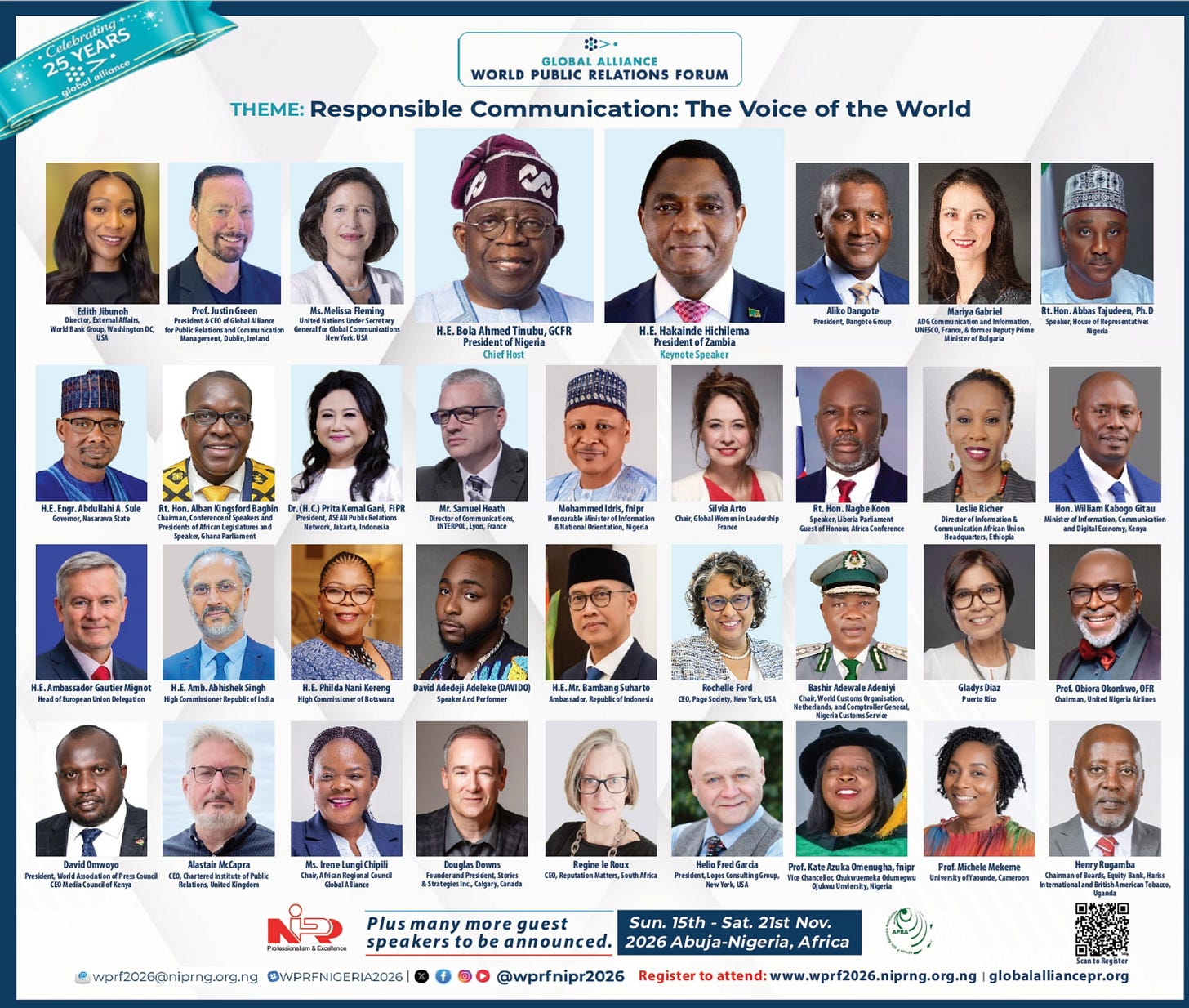
Heading to World PR Forum in Africa to Talk Podcasting
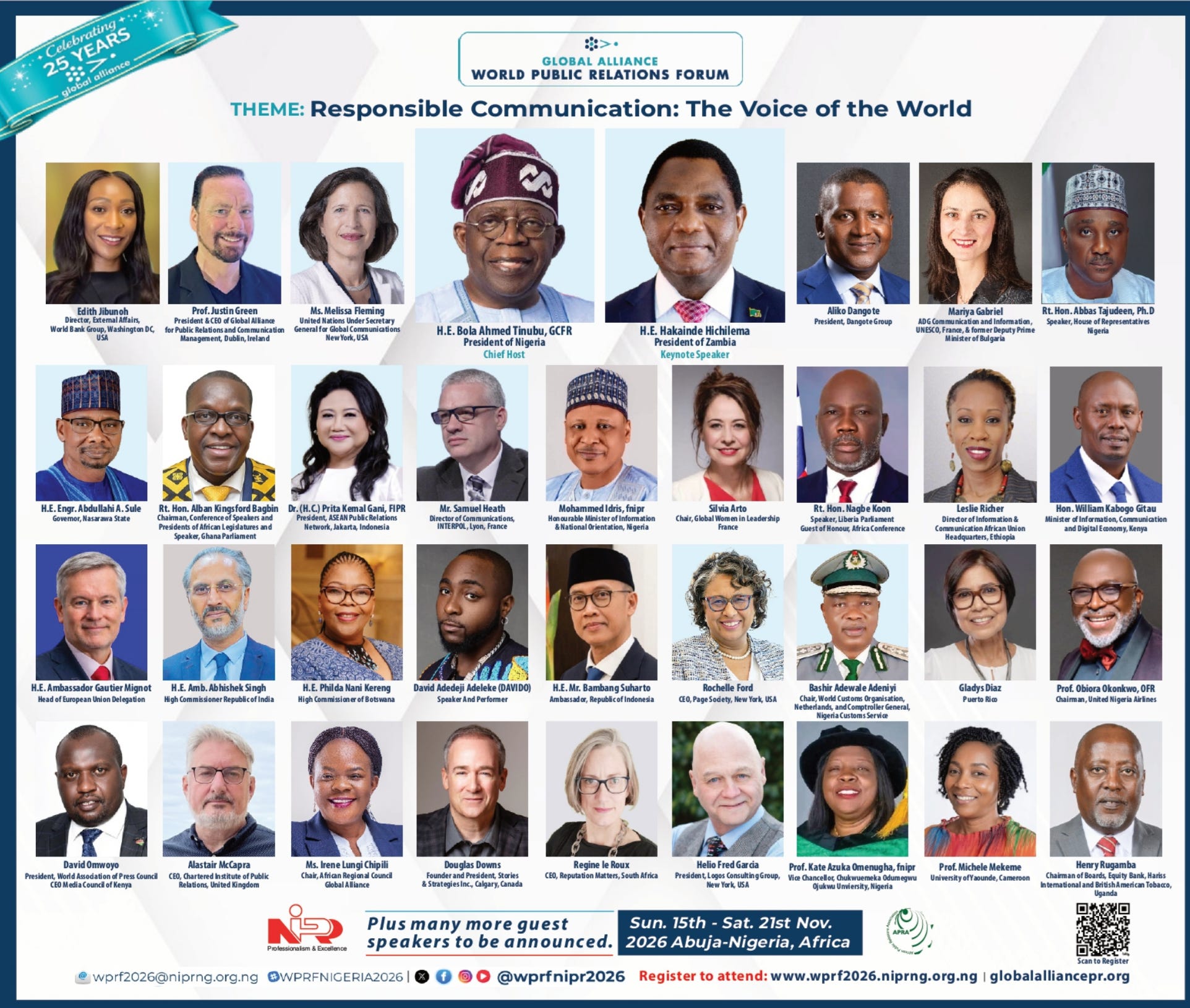
I’ve got news. I’m thrilled to be heading to Abuja, Nigeria in a couple weeks to attend World Public Relations Forum by the Global Alliance for Public Relations and Communications Management. It’s being hosted by the Nigerian Institute of Public Relations.
Podcasting has become one of the most effective ways to develop and maintain trust. Podcasters are more trusted than any authority right now. More trusted than business leaders, politicians, influencers, or journalists. If the goal is trust a podcast has to be a major part of the plan.
But PR pros aren’t tapping into the podcasts the way they could. And it’s no doubt because ROI is so hard to prove with tool that works so effectively in the middle of the funnel and not quite so much at the top (impressions/awareness) or bottom (sales/clicks). Podcasts build the trust that takes people from awareness to action. That’s the message I’ll be bringing to Abuja amongst my world-class brethren in PR.
Other Stuff
RSS.com has launched a series of 120 lessons for podcasters from newbie to pro and they’re free
Instagram is testing 90 minute videos with select U.S. creators, and your Reels clips can now link straight to the full episode.
Writing in The Guardian Imogen West-Knights is “Sick of smug celebrities on the podcast circuit.”
And along the same lines Isabella Parra at the University of Florida begs “Please Stop Making Podcasts.”