
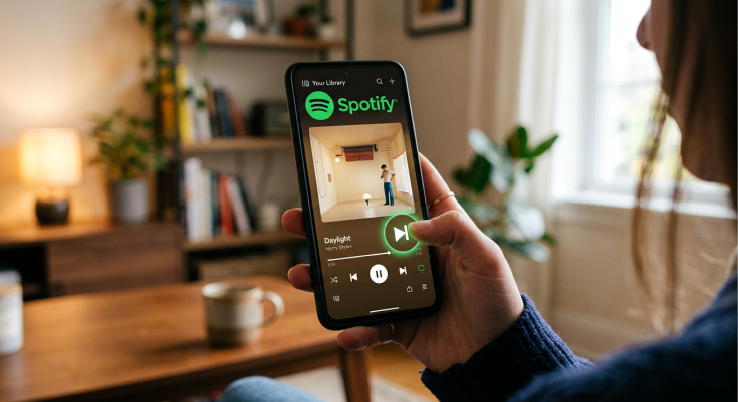
Putting the Spotify Skip-Ad Feature in Perspective
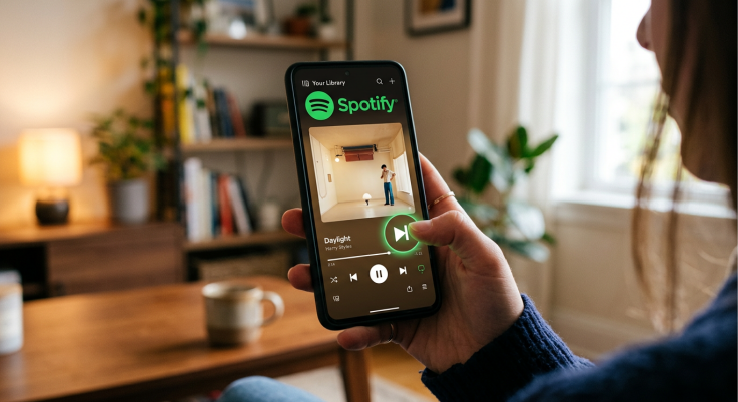
Semafor called it a feature that “could end the podcast business as we know it.” That’s the kind of headline that gets clicks, but it’s not what the data or the advertisers are saying. Spotify quietly tested a “Skip Ahead” button last week that lets some paid subscribers jump past ads, promos, and sponsor reads in one tap instead of nine. That seems a viable threat to ad-funded shows.
Podcast networks panicked. Executives called Spotify to complain. from Crooked Media accused the platform of trying to destroy the industry.
Then the advertisers weighed in, and they weren’t scared. Dan Granger, CEO of Oxford Advertising, told the Hollywood Reporter that ad skipping is “scarier in theory than in practice” and won’t have much material impact on brands. Acast CEO Greg Glenday said the platform’s own numbers show only about 10 percent of users skip ads at all, a rate that’s already priced into the ecosystem.
The story was first broken by at Podnews who did an excellent job noting it could be a "significant threat to ad-funded shows." That’s exactly right… Ad-Funded Shows.
But here’s what the ensuing alarmist framing misses entirely. A huge chunk of podcasts, for example branded shows, aren’t built to sell ads in the first place. They exist to build affinity, not revenue, and a skip button does nothing to that math. If your podcast’s job is to make people feel closer to your brand, whether someone skips a mid-roll spot is beside the point. This story matters if you’re running ad-supported audio at scale. It’s close to irrelevant if you’re a brand using a podcast the way you’d use a blog or a video series, to stay in front of an audience you already have.
Your Show Notes are About to Matter More than Your SEO Habits Assumed
Your show notes might be invisible to AI search and you have no reliable way to check yet. IAB has released new guidance calling “Measuring Visibility in the AI Era,” and it stops short of calling itself a standard on purpose. IAB’s VP of AI Caroline Giegerich saying the industry is still in what she calls a mass transition space, so a real standard has to wait.
The framework breaks visibility into four layers: presence, prominence, portrayal, and persuasion. Presence just tracks whether you show up in an AI answer at all. Prominence looks at where you land in that answer. Portrayal covers sentiment and accuracy, and this is the one that should worry podcasters, since factual inaccuracy from outdated training data is a real risk when an AI describes your show. Persuasion measures whether anyone actually clicks through after being cited.
IAB also drew a line worth remembering if you’re checking your own visibility by hand. Anything under 50 queries is what they call exploratory, not even directional, so a handful of Googling sessions to see how your podcast shows up tells you almost nothing.
For podcasters this matters most in your episode pages and show notes. If AI search is starting to summarize your content instead of sending people to it, the accuracy of what gets pulled from your page becomes the thing you can actually influence. Worth a read before you assume your current SEO habits translate to AI search.
The Numbers Behind Who Actually Wins in Video Podcasting
MillionPodcasts and Feedspot founder Anuj Agarwal analyzed roughly 34,000 active English-language video podcasts and the concentration numbers are striking. The top 10% of shows capture 85% of all monthly listening. The top 1%, about 340 podcasts, account for 42%. The bottom half of the market, around 17,000 shows, collectively generates about 1% of all listening.
Agarwal is honest about what this means: “That’s not a criticism. It’s the same pattern that governs YouTube, streaming music, and best-seller lists. But the gap is worth naming clearly because industry coverage tends to focus on the top of that distribution and quietly forgets the shape of the underlying long tail.”
Here’s the finding worth sitting with. The top 10 shows in the dataset have a median Apple Podcasts rating of 4.65, actually below the dataset average of 4.72. Ratings did not make those audiences. We said it before and the data keeps saying it: ratings are social proof, not a growth engine.
What does unite the top shows is something more structural. All 10 are guest-driven. All 10 carry confirmed sponsor activity. And all 10 are what Agarwal calls “personality-led, video-native franchises,” shows that exist in the same cultural register as a late-night talk program or a true-crime docuseries. Worth noting: this is a study of video podcasts specifically, so YouTube distribution across the top tier is expected. The more pointed observation is for audio-first shows that haven’t made the move: without video, you can’t supply the clips that drive discovery on YouTube Shorts, Reels, and TikTok, and that’s increasingly a structural disadvantage.
His prediction for where growth happens next: the middle tier, shows averaging between 10,000 and 100,000 listeners. Too big to be hobbies, too small for major brand budgets, which makes them the natural target for network signings, ad-tech consolidation, and AI-assisted production tools
Don’t Build Your Media Empire on Rented Ground
My good friend attended the Echo Podcast Summit in Halifax recently and came back with an observation that’s worth sitting with.
Podcasters have become so consumed with social media algorithms, platform discoverability, and chasing reach that they’ve forgotten the thing that makes podcasting uniquely powerful. Ownership.
A website is yours. An email list is yours. The direct relationship you build with a subscriber is yours. A social media account isn’t. If your audience lives entirely on YouTube, Instagram, or TikTok, you’re building on rented ground. The landlord can change the terms, tank your reach, or evict you overnight, and has done exactly that to plenty of creators before you.
The delivery format of your podcast will evolve. RSS, HLS, whatever comes next. That’s fine. What doesn’t change is whether you own the relationship with your audience or whether a platform does. An email address a listener gives you directly is worth more than ten thousand YouTube followers you can’t contact when the algorithm shifts.
Build on things you own. Use platforms for distribution. Know the difference.
What Starbucks and its Baristas Can Teach us About Podcast Growth
Starbucks noticed something a few years ago. Its baristas were already posting about the brand on TikTok, voluntarily, in volume, because the job is visual and the drinks are ridiculous and the green apron is recognizable everywhere. So instead of manufacturing enthusiasm, Starbucks built a system around behavior that already existed. Formalized it in 2024, hired two full-time traveling creators in 2025, and this summer started paying baristas when their videos convert to ads. Steve Raizes writes about this on LinkedIn.
The podcast question that raises: who in your orbit is already talking about your show? Guests, listeners, past clients. Are you finding that behavior, encouraging it, rewarding it, and building any kind of system around it? Or are you starting from zero every episode while organic advocacy happens somewhere you are not looking?
The cautionary footnote, in keeping with Matt Cundill’s point in the top story, is that Starbucks built its entire creator network on TikTok. The audience relationship, the algorithm, the data: all of it lives on TikTok’s servers. Starbucks can absorb that risk because it has 35 million Rewards members to send traffic to. A podcast with no owned destination running the same play is building value it cannot place.
Find the organic behavior. Build the system. Just make sure you own somewhere for the attention to land.
Other Stuff
Quick Tip - You want to be mentioned in Gemini. YouTube Shorts is becoming a dominant contributor to Gemini results