
Do Captions Help Your Podcast on YouTube?
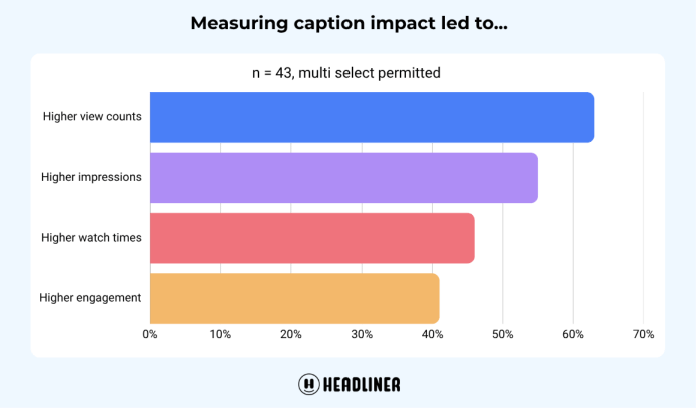
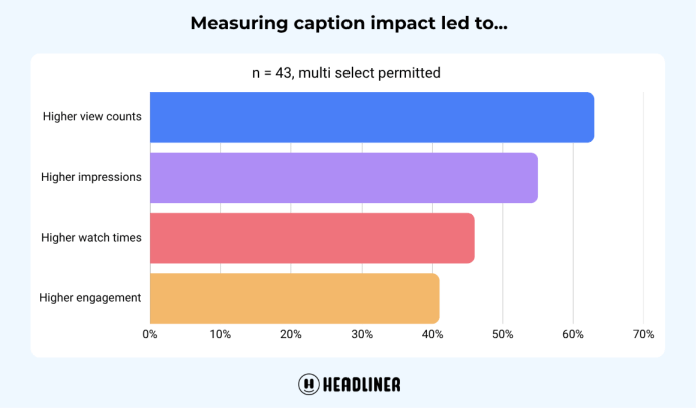
Podcasters who caption their YouTube uploads reported the numbers moving: 63% saw higher view counts, 55% more impressions, 46% more watch time, and 41% more engagement, according to a new Headliner survey.
That might sound like a strange result given YouTube has offered free auto-captions for years, but the gain isn't really about adding captions, it's about replacing bad ones. Auto-captions are the default the moment you upload, and they routinely misread guest names, jargon, and accents in ways that weaken the search indexing podcasters are counting on.
Only about 24% of podcasters caption consistently with something better, either burning captions directly into clips or uploading their own transcript files for full episodes. The other 76% are letting YouTube's machine transcription stand as the only text attached to their video, errors and all.
One gap worth flagging: the survey doesn't break its results out by video length, so it's not clear whether full episodes saw the same lift as clips and Shorts, and given that scrolling with the sound off is mostly a short-form behavior, it's worth asking whether captions are doing more work there than on long-form video.
Podcast Advertising Works. And Bigger Shows Don’t Convert Better
New Q1 2026 benchmark data from Magellan AI, drawn from actual measured campaigns, puts some real numbers on podcast ad performance. Of listeners reached by a podcast ad, 2.29% visited the advertiser’s site within 30 days. Of those visitors, 9.74% converted to a lead and 5.22% completed a purchase. And 87% of responses happened within the first 30 days of exposure.
Those are solid numbers across the board. But the finding worth sitting with is this: show ranking had nearly no effect on purchase conversion.
Top 500 shows did drive stronger lead conversion, meaning more people raised their hand to learn more. But when it came to actually buying something, smaller shows performed just as well as the biggest names in podcasting.
For a podcaster pitching sponsorships, this is useful ammunition. An advertiser’s instinct is to chase reach and recognizable show names. The data suggests that for purchase outcomes, the audience’s trust in the host matters more than the size of the audience. A tightly focused show with 2,000 loyal listeners in the right niche can deliver the same purchase conversion rate as a show with 200,000.
The Podcast Hosts Publishing the Most New Episodes
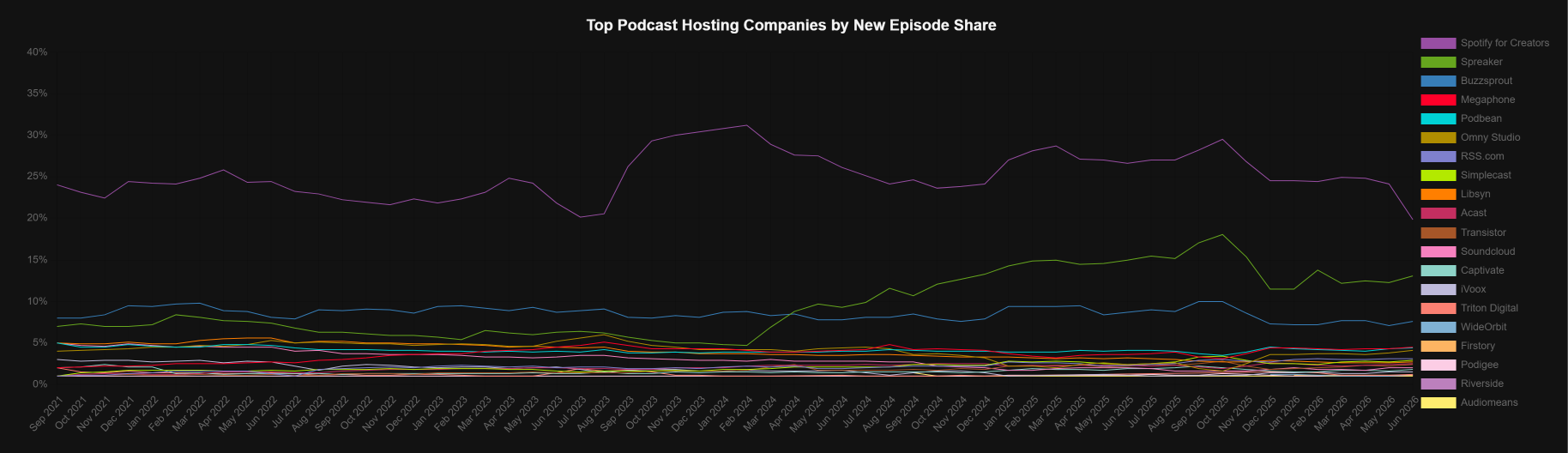
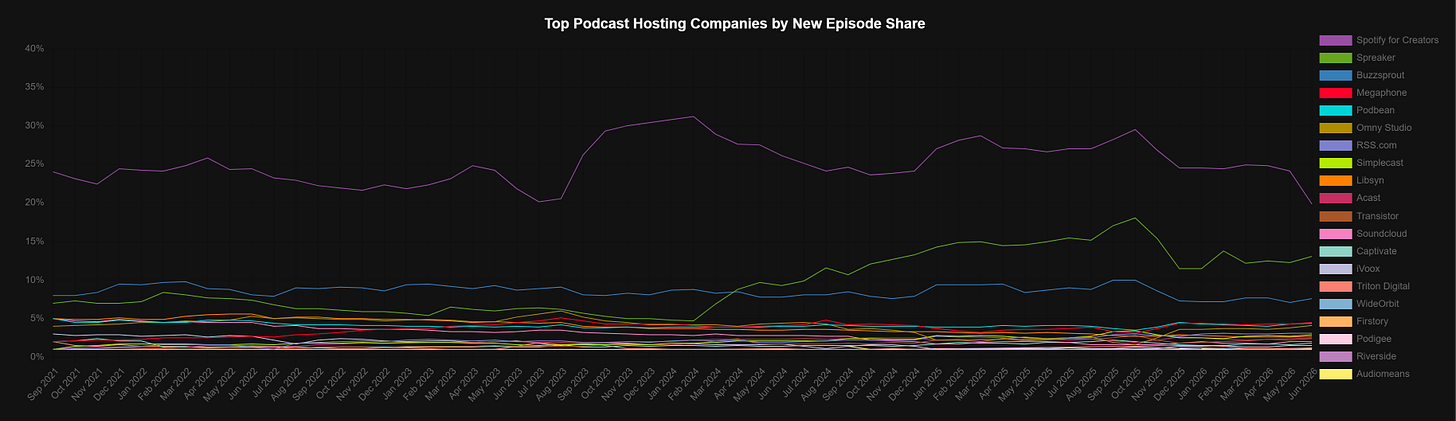
The June episode share chart from livewire.io appears to show Spotify for Creators losing ground, but the site's own footnote says their Spotify data source was down for several weeks and should return to normal next month, so treat that dip as a measurement gap rather than real news.
What is real: Spotify for Creators and Spreaker have held the top two spots for years, and both got there the same way, by offering free hosting with no storage caps. But free comes with trade offs, including Spotify's right to edit or remove creator content without warning and a possibly as much as a 50% cut on ads served through its own network.
Meanwhile, a quieter story is playing out further down the chart. RSS.com has tripled its episode share since September 2021, climbing from 1 percent to 3.1 percent and passing established hosts like Libsyn, Acast, and Simplecast along the way. The lesson for growing shows: free hosting is a fine place to start, but it is worth outgrowing once a podcast is more serious and has a brand reputation to protect.
And cheers to Buzzsprout which continually leads the pack among paid hosts.
Cool Tool 1: Podscribe Now Tracks Social Alongside Podcast Campaigns
If you run podcast advertising campaigns, this is a meaningful update. Podscribe has added automated social media tracking that pulls engagement data from Instagram, TikTok, and YouTube directly into the same dashboard as your podcast attribution and conversion reporting. No manual setup, no separate platforms to check.
Cool Tool 2: SpotsNow Now Connects to Claude and ChatGPT
SpotsNow has opened its podcast advertising intelligence platform to Claude and ChatGPT via MCP connector. The idea is straightforward: instead of manually digging through scattered data to find which brands are running on a show, pull lookalikes, or build a media plan, you ask a question in plain language and get an answer in seconds. The dataset covers 61,000+ commercially relevant shows with sponsor data, spend tracking, and fill rates.
Cool Tool 3: Japanese Translation that Sounds Native
Otonal has launched a new service to turn English-language podcasts and audio ads into Japanese versions that actually sound native, not just translated. The company says literal translation falls short because Japanese grammar, tone, timing, and calls to action work differently.
This is a century-old lesson. When Coca-Cola first appeared in China in 1928, some local renderings tried to match the sound of “Coca-Cola” (可口可樂, pronounced "kěkǒu kělè). But they produced meanings like “bite the wax tadpole” or “female horse fastened with wax.”
Coca-Cola later settled on 可口可乐, usually interpreted as something like “tasty and joyful” or “delicious happiness.”
Cool Tool 4: What If Your Podcast Was Also a Game?
Matt Medeiros at The Podcast Setup built a retro arcade-style trivia game for his podcast Agency Action. Every Tuesday when a new episode publishes, his system ingests the RSS feed and transcript and automatically generates an eight-question educational challenge based on that episode’s content.
The game is a novel idea, but the bigger point is worth sitting with. Your RSS feed and your transcript files are a dataset. Most podcasters treat them as plumbing. Medeiros treats them as raw material for building listener experiences that go beyond the feed or the YouTube channel.
You don’t have to build a game. But if you have a backlog of episodes with transcripts, you have something most content creators don’t: a structured archive of your own expertise, ready to be turned into something.
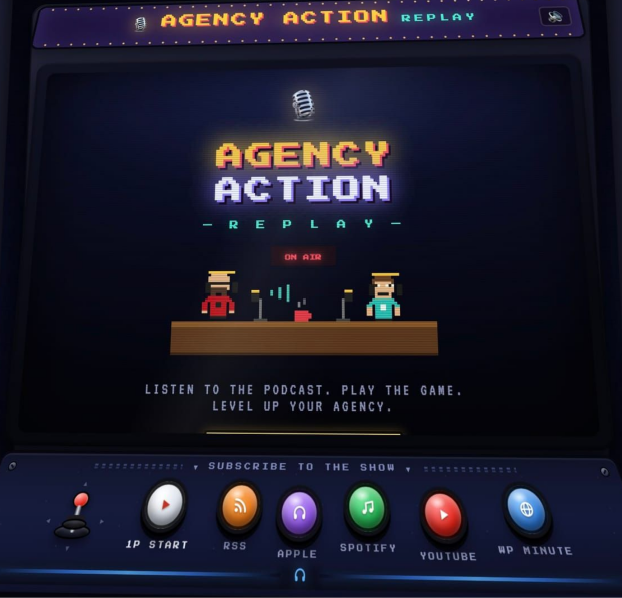
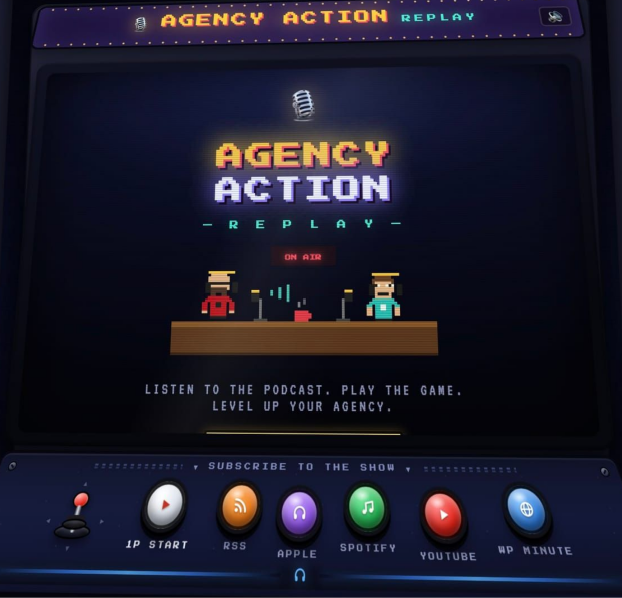
Image captured from The Podcast Setup
Other Stuff
The podcast industry is now a $9B industry according to Owl & Co. It grew from $7.5B last year
What does social media do for your podcast anyway? and Holly Brown deep dive in this video
Two separate hosting platforms, Buzzsprout and Transistor, are showing the same trend in their June data. Overcast consumption is up 28% year over year on Buzzsprout and 22% on Transistor. Spotify is moving the opposite direction, down on both platforms. Apple Podcasts is holding steady with modest growth.