
What the Podcast Atlas Means if Your Show Is a Branded Podcast
The Podcast Atlas from Sounds Profitable made waves when it launched at VidCon last month with its findings on how audiences move between audio, video, clips, and newsletters. Most of the coverage focused on the creator economy and independent shows. But I wanted to know what it means specifically for branded podcasts, the kind we produce every day at Stories and Strategies.
So I sat down with , the researcher behind the Atlas and one of the most respected voices in podcast audience research, to ask him directly. Here is what stood out.
On conversion and branded podcasts
The 10% audio versus 15% video conversion gap is largely explained by the number of clickable surfaces in each format, not by the persuasive power of the content itself. YouTube has more places to click. An audio file has none.
For branded podcasts, conversion rarely means someone hears an ad and buys immediately. It means someone finishes an episode and then registers for a webinar, downloads a white paper, or signs up for a masterclass. The podcast moves them along a journey.
Branded podcasts are exceptional at changing hearts and minds about what a company stands for. That kind of impact does not show up in transactional data but it’s real and measurable through surveys and customer feedback.
On smaller shows
Shows with 500 to 1,000 listeners or plays per episode convert better than large shows because their advertisers and sponsors are far more relevant to the specific audience. Niche content plus niche advertising equals higher conversion. As Tom put it: the riches are in the niches.
On social media and clips as discovery tools
Organic reach on social has declined for nearly a decade but the denominator, meaning the sheer number of people you can potentially reach, is still far larger than word of mouth alone. Tom’s analogy: if you used to get two dollars back for every dollar you spent on social and now you get a dollar forty, you’re still ahead. You keep spending the dollar.
Word of mouth converts at a higher rate but is limited by Dunbar’s number, roughly 150 relationships. Social converts at a lower rate but reaches a far larger pool. You need both.
A clip works when it is a complete thought in itself, not a teaser or an unfinished sentence. If it pays off fully in the short-form space, it has a chance of being a bridge to your show.
On AI and where the Atlas goes next
The unfinished question Tom couldn’t answer yet is how audiences will react to AI-generated content as the quality continues to improve and AI becomes as ordinary as any other tool.
Tom’s honest position: he’s not on the side of the robots, but he’s also not willing to make definitive statements about what people will or will not accept because it’s a moving target that’s moving very fast.
The bullets here barely scratch the surface of the insight Tom offers here. The full video is barely 17 minutes and well worth the watch below:
If it Works With Your Eyes Closed… it’s a Podcast
The AMP Accords published the first cross-measurement standard in history. Within it they offer a definition of a podcast. Basically, if it works with your eyes closed it’s a podcast.
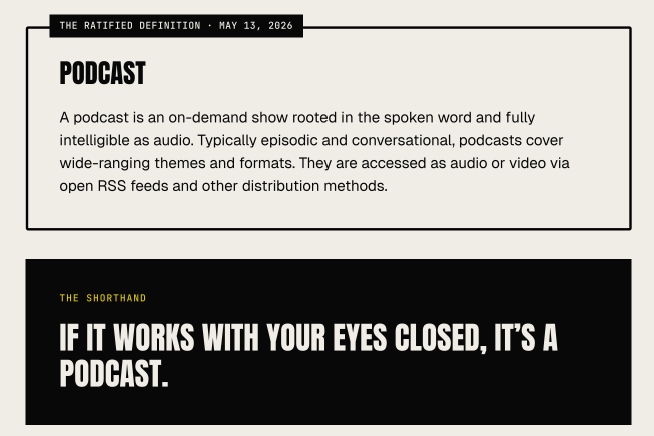
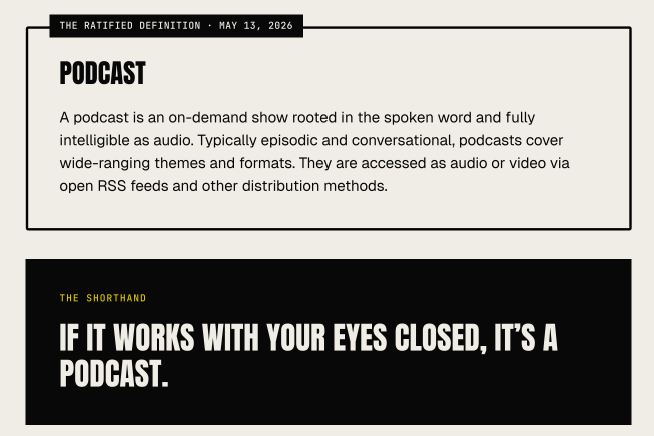
Advertisers can't price what they can't define, and without a shared standard the same content was being counted as a download in one deal and a video impression in another, creating confusion that kept over a billion dollars in ad spend sitting on the sidelines. A clear definition gives buyers, platforms, and creators a common reference point so budgets have a clear home instead of getting lost in the gap between audio and video.
Apple's Smart Home Hub Is Good News for Audio
Apple is launching a smart home hub device in the coming months, a screen-based device that sits on your desk or mounts on your wall and brings Siri AI into your home. Think Amazon Echo Show but Apple.
In this video, Mark German discusses the full Apple product launch. Fast-forward to the 41:13 mark.
For podcasting, my take is that this reinforces audio habits more than it advances video. A screen in the kitchen while you cook or clean is not where someone chooses to watch a video podcast intentionally. It’s where someone puts on a show the same way they’d put on music or talk radio. The Nielsen data we covered earlier is relevant here: 47% of podcast listeners already consume during household chores, and 90% of all podcast consumption is still audio.
What this device does is add another always-on surface to that ambient listening habit, one that happens to be in Apple’s ecosystem and will almost certainly support Apple Podcasts natively. For podcasters, more surfaces where audio plays in the background is a good thing. It’s just not the video revolution some might assume a screen implies.
Fewer New Podcasts Is Good News For Yours
Fewer people are launching podcasts right now, and that’s actually the good news.
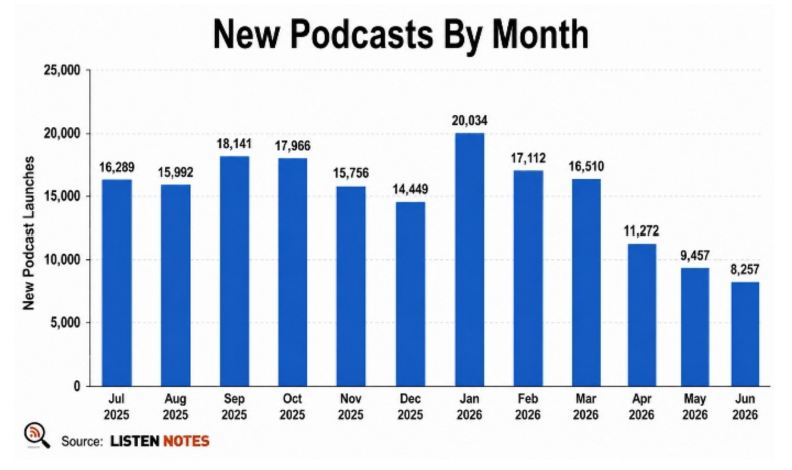
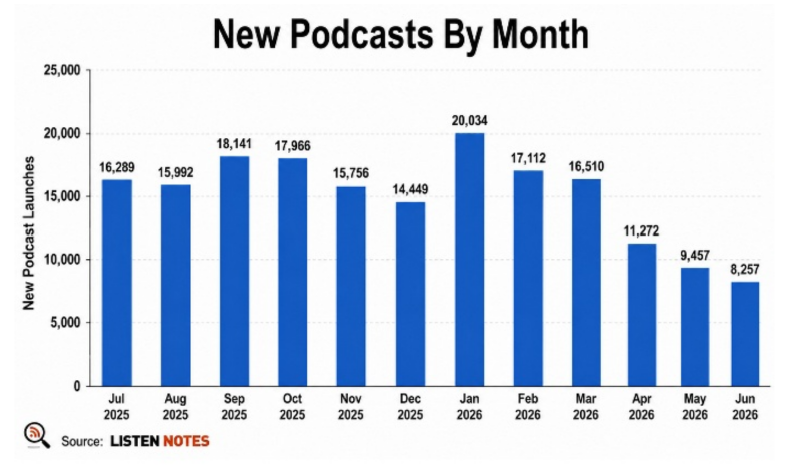
Listen Notes counted 8,257 new podcasts in June, the slowest month of 2026 and 1,200 fewer than May. Follow that trend line and this year is on pace for the fewest launches since 2017. That sounds like decline until you look at what’s happening underneath it.
Active shows are up. Way up. Listen Notes tracked 519,708 active podcasts so far this year, more than double last year’s number and the highest since the pandemic boom of 2021. Those active shows have already released over 14 million episodes. Death rates are down too, with 10,662 podcasts declared dead in 2026, well under pandemic era levels.
Here’s the part that actually explains the slowdown. Listen Notes has been scrubbing AI generated junk podcasts out of its database, and removals hit 4,389 in June alone. Over the past 13 months the platform has pulled almost 63,000 fake AI feeds. Some of the “growth” the industry bragged about in recent years wasn’t creators. It was bots publishing noise.
If you’ve got a real show, this is your moment. Fewer new entrants and a database getting cleaned of fake competition means less clutter around your podcast, not more. The takeaway isn’t that podcasting is shrinking. It’s that the junk is finally getting flushed out and legitimate shows are what’s left standing.
I Swapped my True Crime Podcast for Chat GPT Voice for a Week
Amanda Caswell swapped her daily true crime podcast habit for ChatGPT’s Advanced Voice Mode for a full week, prompting it to narrate real cases, build suspense, and even invent entirely fictional mysteries from scratch. She found the interactivity, being able to interrupt, redirect, or ask for more detail mid story, was the biggest advantage over passive listening, and the fully original stories turned out to be the real standout. The AI wasn’t perfect, repeating itself at times and needing pushes to keep going, and she still recommends fact checking any real cases against reputable reporting. Her verdict: she is not ditching her favorite podcasts yet, but the format won her over more than expected, especially for choose your own adventure style storytelling.
Other Stuff
Cool Tool: Pocket Casts is now free on Apple TV, syncing your Up Next and listening position across every device, with Android TV on the way
Cool Tool: PodToBook.ai. An AI platform that turns your back catalog of episodes into a professionally structured book manuscript, transcribing, reorganizing, and rewriting your conversations into readable chapters you review and approve before publishing. It just hit its one year mark with more than 100 podcaster books published, which suggests it’s for hosts who want their best conversations to outlive the 48 hour shelf life of an episode
Oprah has announced she’s expanding her podcast to 2x weekly