
Podcasters are the Only Creators Gaining Trust Right Now
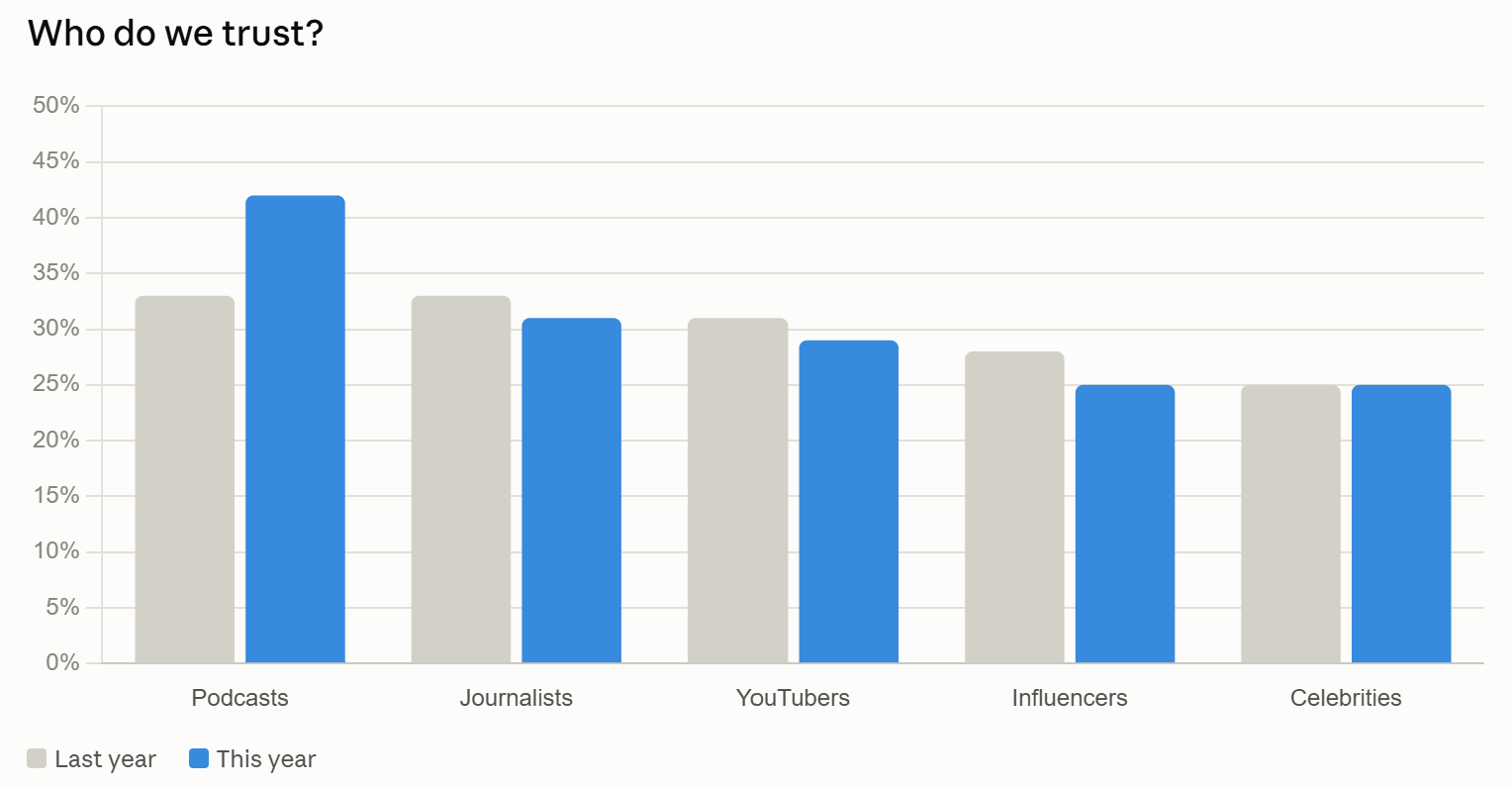
Acast’s Podcast Pulse 2026 report is out, and podcasters have something to feel good about that has nothing to do with downloads or reach. Trust in podcast recommendations climbed from 33% to 42% this year. Every other creator category in the report either held flat or dropped:
Journalists slipped from 33% to 31%
YouTubers fell from 31% to 29%
Influencers dropped from 28% to 25%
Celebrities sat still at 25%.
At a moment when trust in media broadly is eroding, podcasters are the one category moving in the opposite direction. That’s the kind of stat that should show up in every pitch deck a podcast producer sends to a brand this quarter, because it’s not just a podcasting stat, it’s a competitive one. Podcasters aren’t just holding ground. They’re pulling away from every other influencer category the report tracked.
Audio listeners took action after an episode 81% of the time, with nothing to click. No link, no prompt, just a person alone in the car or the kitchen acting on something a host said. That’s the kind of trust that gets built in an earbud, not on a feed, and it’s likely a big part of why podcasters are climbing while feed-based creators are flat or falling.
The report also shows format habits are shifting underneath all of this. The share of fans consuming audio and video equally jumped from 27% to 39% in a single year, and the pure audio only and video only extremes are both shrinking. Listeners aren’t picking a lane anymore. They’re following the host wherever the host shows up.
One stat worth a caution here. The report states that 63% of listeners have started a podcast in one format and finished it in another. Some reporting on this release has framed that as evidence of a routine crossover habit. The report itself doesn’t say that. The wording is past tense, meaning most listeners have done this at least once, not that most listeners do it as a matter of course.
Live events are the other place this trust is showing up as revenue. Attendance at live podcast events is up 80% since 2024, and 28% of attendees bought something directly from a sponsoring brand.
Put it together and the throughline is simple. While trust in almost every other kind of creator is stalling out, podcasters are becoming more persuasive, not less, and the format wars that used to dominate this conversation matter less than who the audience actually believes.
The Host Is the Podcast
New research out of The Podcast Study 2026 puts a number on something most podcasters have felt intuitively. Among listeners with a favorite show, 82% say the host is either a big part of or the only reason they listen. That’s not a preference. That’s the whole relationship.
It shows up hardest in what listeners will and won’t tolerate. Fifty six percent say they’d stop or seriously consider stopping if the host left permanently. But 78% would keep listening through a vacation. Listeners aren’t loyal to the format or the topic. They’re loyal to the person, and they can tell the difference between the host stepping away and the host leaving.
That trust carries into the ad break too. Host read endorsements beat prerecorded ads by a wide margin, 40% likely to try or buy versus 27%, a 48% relative lift. And 45% of listeners said they’d pay for a tier that strips out every ad except the host read ones. That’s not an ads versus no ads choice. It’s a third option built entirely on trust in one person’s voice.
The next webinar in the series, Turning Listeners Into Superfans, runs October 6.
Inception Point is Still Missing the Point
Remember that company I told you about a couple of months ago? The one running entirely AI episodes, including medical podcasts with AI doctors? The one pumping thousands of episodes a week into the podcast world?
It just scaled way back. Inception Point AI once ran more than 15,000 active shows. Today it runs about 300, and it isn’t trying to make money from any of them. CEO Jeanine Wright told the Lead Balloon podcast they’re now a sandbox, and ’ reports she also called some of the early publicity a PR strategy to get attention (note to the reader - PR means “relating to the public” which this didn’t do - this was a marketing stunt).
What catches my attention is that the company is still selling synthetic hosts. And Wright still seems to be missing the most fundamental point about podcasting, which is also the most fundamental point about broadcasting: people stay with human beings.
Knowledge transfer (dubious to begin with in the case of Inception Point AI) isn’t why people listen to podcasts. It’s the human experience that carries the knowledge along with it. An AI host can deliver accurate information and still never become someone you look forward to spending time with. It never will, because there’s no life behind the voice to connect with.
Wright even offers a definition of slop: heavy volume, little creative input, minimal cost, monetize the difference. She was asked whether that described her early model but she didn’t answer and changed the subject.
The Podcast With Fewer Listeners Just Beat the Podcast With More
Call Her Daddy is one of the biggest podcasts in the country. It also scored in the 14th percentile for engagement, according to Podscribe’s data in Audacy’s new advertising study. Sofia with an F, a fraction of the size, scored in the 100th percentile. Fewer listeners. Dramatically better engagement.
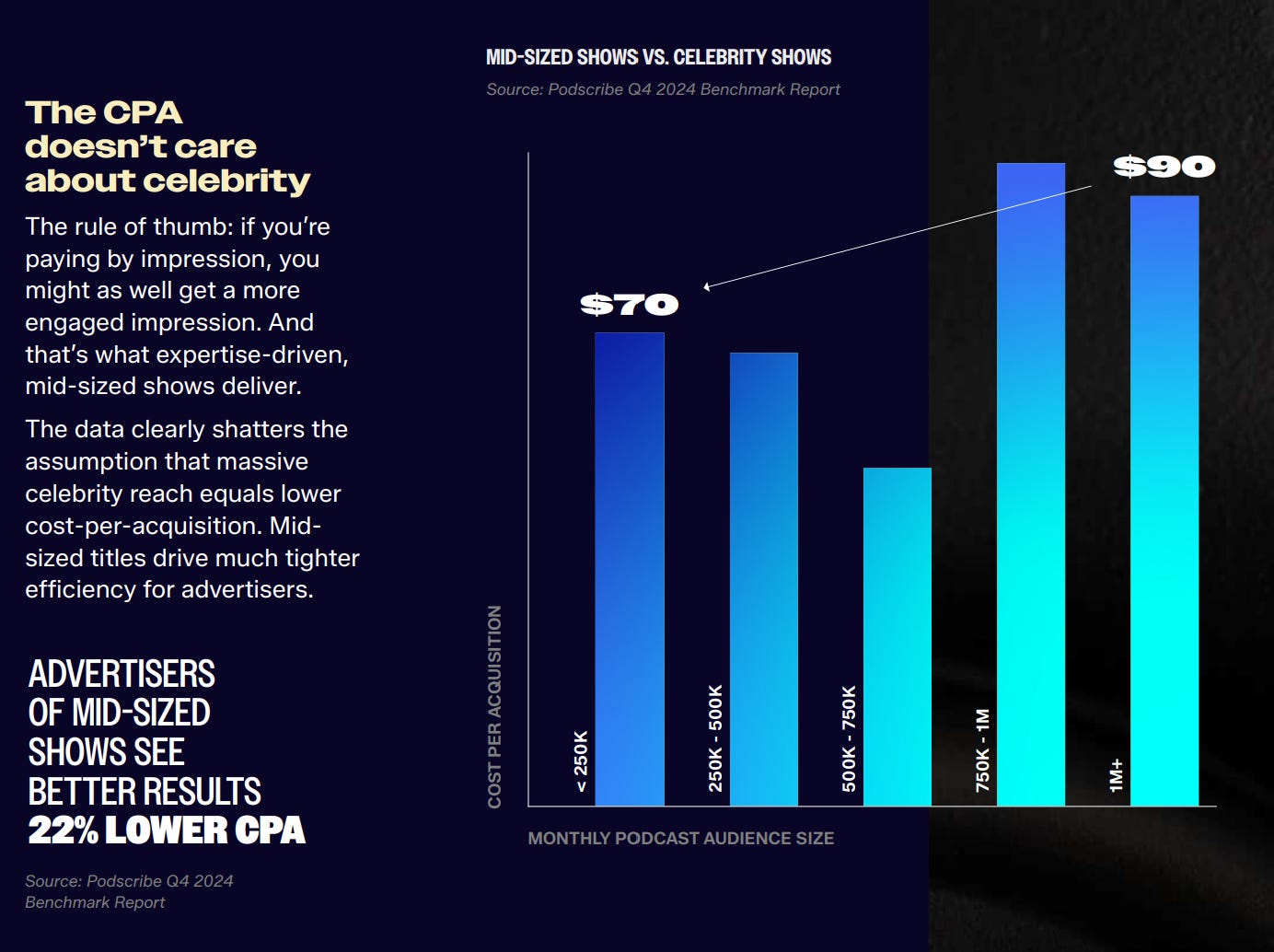
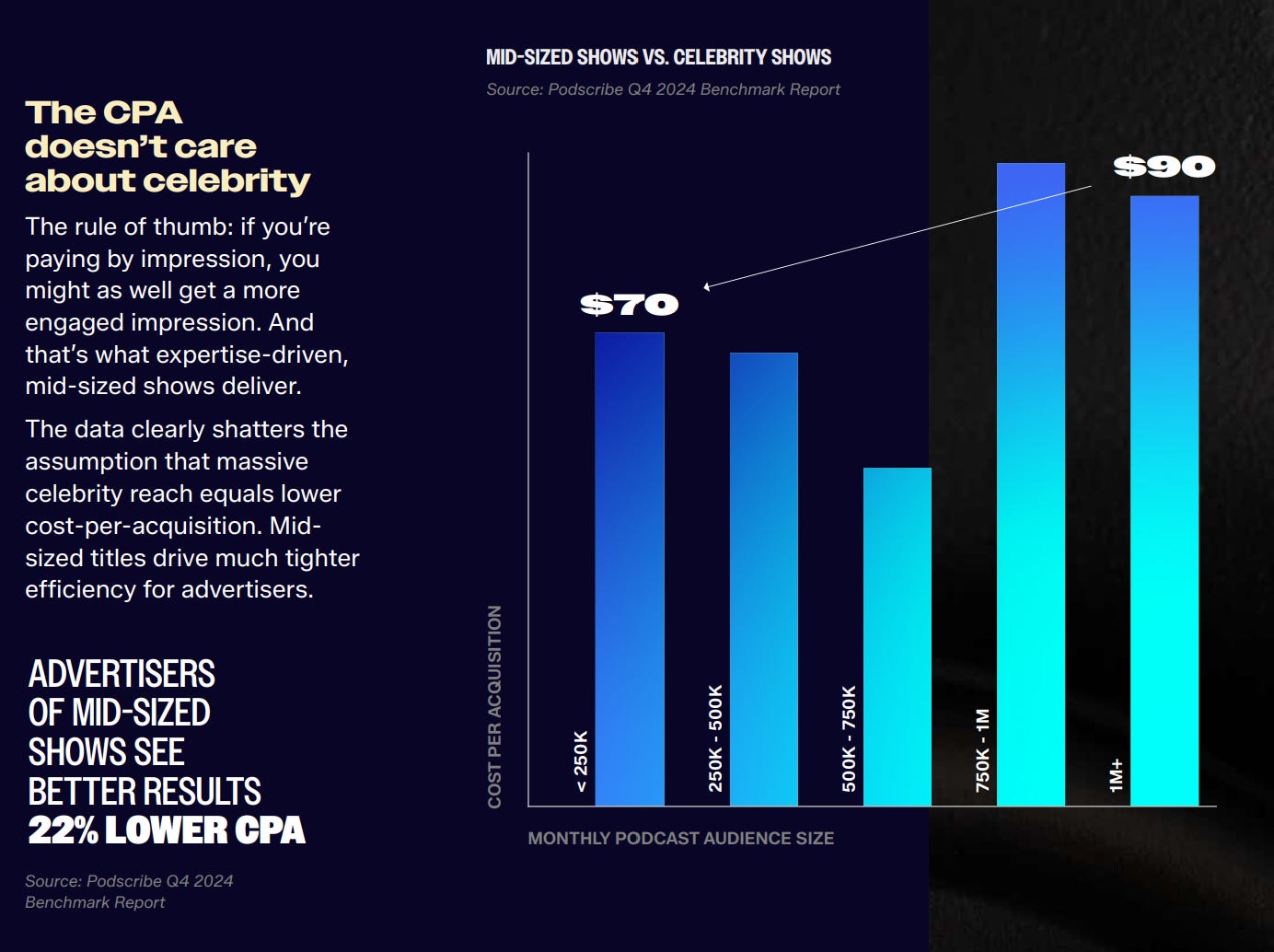
That gap is the real finding buried in an otherwise familiar seasonal Audacy report, and it should worry anyone still buying podcast ads by download count. The study puts a real number behind it too: advertisers on mid-sized shows see 22% lower cost per acquisition than the industry average, and cost per acquisition climbs steadily as audience size grows, from $70 on shows under 250,000 monthly listeners to $90 on shows over a million. Audacy’s own term for this is the “midfluencer,” a host with no celebrity profile but a loyal audience who’s been there since episode 12.
I’d push back on one thing before you take this to your media plan. Audacy sells ad inventory across shows of every size, so a study telling advertisers to stop overpaying for celebrity reach is also a study telling advertisers to buy more inventory generally, mid-sized shows included. The finding doesn’t have to be wrong for that to be true, but it’s worth knowing who benefits from the conclusion before you repeat it to a client.
What’s actually useful here isn’t the advice to “find niche shows,” which podcast people have said for years. It’s that trust and reach aren’t the same asset, and buying one doesn’t get you the other. A host who’s been in someone’s ears every week for two years has a credibility a celebrity licensing deal can’t replicate, no matter the download count attached to it. If you’re planning ad buys or pitching sponsors on your own show, that CHD versus Sofia with an F gap and the 22% CPA number are the two things worth keeping in your back pocket. It’s a lot easier to make the case for a smaller show’s rate card when there’s real data behind why it works.
YouTube Is About to A/B Test Your Cold Open
YouTube just extended its A/B testing tools past titles and thumbnails into the video itself. Creators have already run more than 40 million experiments on titles and thumbnails since 2024, and now that same system will test up to three video cuts to find which hook performs best. Your first few seconds are becoming a data point, not just a creative choice.
There’s a second piece worth knowing about. YouTube is also running background AI passes on older videos to test and refresh thumbnails automatically, meaning your back catalog keeps getting optimized long after you’ve stopped thinking about it.
If you post podcast video on YouTube, both of these are levers worth watching, even if you’re not ready to use them yet.
Our Website Let's connect on LinkedIn Our YouTube channel The Stories and Strategies podcast on Apple, on Spotify And on YouTube