

What a 100 Million Dollar Podcast Deal Teaches a 200 Download Show
Forbes just published its list of the highest paid podcasters of 2026, and the numbers are absurd. Jay Shetty landed a combined Spotify and Netflix deal worth an estimated 100 million dollars over three years. Rogan, Poehler, the Kelce brothers, all in the tens of millions.
If you’re recording a branded podcast that pulls a few hundred downloads an episode, this is the part where you’d normally close the tab. Don’t.
Steve Raizes, the former Paramount podcast chief who now runs Sine Wave Strategies, wrote something on LinkedIn that’s more useful to you than to Shetty. He points out that guarantees at that level are now so large that ad sales alone can’t cover them. An entertainment lawyer told Forbes that if a client’s show actually earned out its guarantee, the network would have made a bad deal. Raizes’s read is that this isn’t a mistake. The money isn’t really a bet on the podcast as content. It’s a bet on the audience as an asset, one a brand values the way it would value an owned marketing channel, because that audience shows up when asked to, buys, subscribes, or follows the host somewhere new.
That’s the part that applies to you even though your numbers look nothing like Shetty’s. Nobody is going to hand your branded show a nine figure guarantee. But the underlying question Raizes is describing, whether an audience will actually do something when you ask it to, isn’t a scale question. It’s a relationship question, and it’s one you can answer at 200 downloads an episode just as clearly as a network can answer it at 200,000. A show that a hundred people trust enough to act on is doing its job. A show that a thousand people half listen to and forget isn’t, no matter what the download count says.
If you’ve got a podcast sitting there and you’re not sure whether it’s worth investing in properly, that’s the actual test. Not whether the numbers are big. Whether the people listening would do something for you if you asked. Sometimes the lineup is at the smaller door.


Reason 3,128 Your Podcast Needs a Newsletter
Your unopened newsletters are training AI to talk about your brand. Whoa!
Garrett Sussman of iPullRank tells Vince Nero at he found that a newsletter he never even opened still got cited by AI months later, just for sitting in his inbox. Start a newsletter for your podcast. If your show doesn't have a one, there's nothing there to find.
5,000 Fake Hosts Killing Your Discoverability
Inception Point AI runs more than 5,000 active podcasts, and most of the people hosting them don’t exist. The company just rebranded as Liquify AI, and its own homepage links straight to the New York Times piece that prompted this mention in the newsletter. Make of that what you will.
Staff build each AI persona a 15 to 30 page “bible” covering appearance, voice, and biography, then hand it a fabricated tragedy, a dead sibling, a climbing accident. The Times puts it plainly: these characters “are often given personal struggles... to make them seem more relatable.”
Here’s what that sentence skips over. A bot can’t be more relatable. It’s like trying to relate to your coffee table. It can only be fed a script written by humans who studied what other humans find relatable, then perform that script back at you. That gap between simulating an emotion and having one is the weakest point in every AI persona pitch I’ve seen.
The math is blunt either way. An episode needs just 20 listeners to turn a profit once you’ve stripped out the cost of an actual host. Episodes aren’t consistently labeled as AI generated at the individual level either, only on the main show page, so a listener scrolling Apple or Spotify may never clock that the “person” talking to them was built to fill a demographic gap.
CEO Jeanine Wright frames this as consumer choice, more niches served. I’d call it a company that figured out you don’t need an audience if you never needed a reason to exist beyond ad math.
Here’s who I actually worry about. A show with an established host and a loyal audience isn’t losing listeners to a fake gardening podcast. The threat lands on smaller independent shows, the ones already fighting for a sliver of discoverability on Apple and Spotify. When a platform’s search and recommendation algorithms can’t tell your real, hard-earned expertise from 5,000 AI shows optimized to hit every keyword, you’re not competing with Liquify. You’re getting buried by it.
Cool Tool: Mato
And just to emphasize I’m not a Luddite, let me walk you through Mato. It pairs an AI host with a real human expert for a live, unscripted interview, then hands you a finished episode in 30 minutes. It’s built for business owners who want to be the guest, or the resident expert, without booking a producer, an editor, and a co-host just to make that happen.
Here’s why I’m ok with this one. The expert on the mic is a real person with real knowledge. The AI isn’t performing a fabricated life story, it’s just asking the questions and following up on what the human actually says.
I’ll also say the quiet part. An AI host isn’t going to read a guest’s hesitation and pivot the way a skilled interviewer does. It won’t build the kind of rapport that gets someone to say the thing they didn’t plan on saying but honestly did want to. Interviewing well is a deep, specific skill (I’ve been doing it professionally since 1986), and Mato doesn’t replicate that because it can’t. What it does replicate is the baseline: a coherent conversation, decent follow up questions, and a finished episode without a production team.
So think of it less as a replacement for a great host and more as a floor. If the alternative is no podcast at all because the production lift felt too heavy, Mato is a real, no frills way to get started. Just don’t mistake it for the ceiling.
Downloads Aren’t the Point. Trust Is
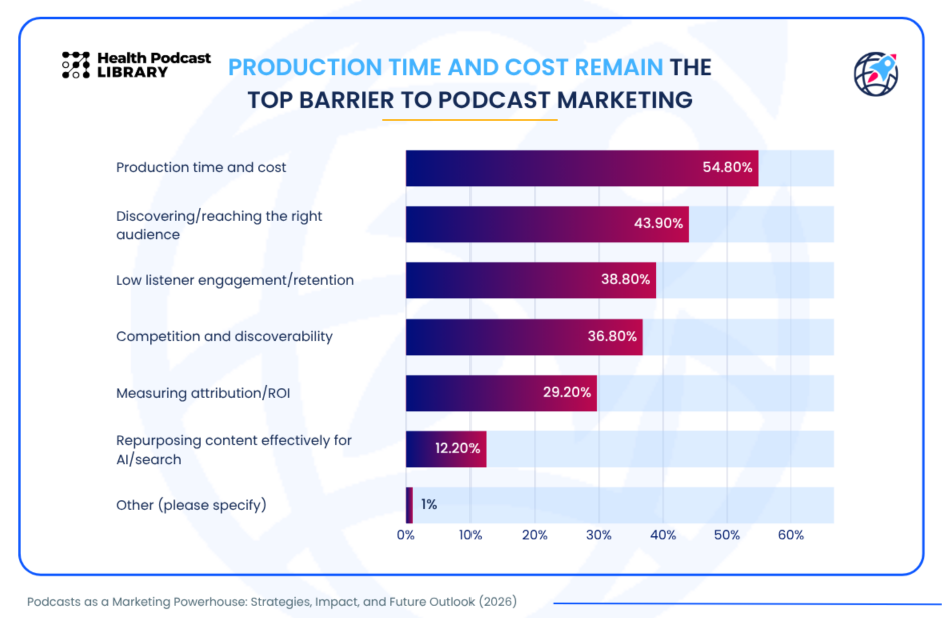
Nearly half of marketers now use podcasts, but almost half of the holdouts aren’t skeptical about production or budget... they’re skeptical the channel actually works. A new survey suggests that’s a measurement problem, not a podcasting problem.
The survey was done by Prolific for Outcomes Rocket and Health Podcast Library. 861 respondents.
One gap worth flagging, the survey lumps marketers and PR professionals into one pool for every single stat. Those are two different jobs with different goals. A PR person cares about earned coverage and sentiment. A marketer cares about pipeline.
With that caveat in place, the findings still reveal a genuinely strange gap. Audience engagement, defined in the survey as completion rates and shares, gets tracked by 70.8%. Downloads follow at 61.2%. Keep following the money and it thins out fast. Only 32.8% track lead generation, 20.4% track revenue attribution, and just 16.8% measure actual ROI. Despite that, 47.3% still call their podcast’s ROI strong, meaning a lot of people are declaring victory using metrics that have nothing to do with revenue.
If you’re pitching a branded podcast internally or defending a renewal, this is your reminder that the win isn’t in the download count. It’s in whether people trust you enough to come back, and eventually follow your CTA.
YouTube’s View Counts Just Got Bigger. Getting Paid Just Got Harder
Starting August 24, YouTube counts a view the moment a video starts playing, not after 30 seconds like before. Your public numbers are about to look better than they ever have. Quietly, the same week, YouTube doubled the watch hour threshold new creators need to actually get paid, from 4,000 hours a year to 8,000. The number everyone sees is getting easier to inflate. The number that pays the bills just got harder to hit. If you’re leaning on YouTube for your podcast’s video distribution, know which number you’re actually chasing.
What This YouTube Report Actually Means for Podcasters
WARC released a detailed (subscribers only) YouTube platform report a couple of weeks ago and most of the coverage focused on the big advertising numbers. Fair enough. But two findings buried in the data matter specifically for podcasters and didn’t get much attention.
First, viewers watched more than 700 million hours of podcasts on YouTube via TV screens in a single month, up 70% year over year. Not on phones. On televisions. The living room is now a serious podcast screen and YouTube owns it.
Second, YouTube has now eclipsed Reddit as the leading source platform for large language models. If you want AI to surface your podcast when someone asks a relevant question, having your show on YouTube is no longer just a discovery strategy. It’s an AI visibility strategy.
The broader context: YouTube’s ad revenue growth is slowing, forecast to drop to 7% this year from 11.7% in 2025, with TikTok potentially overtaking it by 2028. The platform is maturing. But for podcasters, the audience numbers and the AI signal both point in the same direction.


Apple Podcasts Just Hit a Quiet Speed Bump
Apple’s Services segment, which houses Apple Podcasts, posted a headline record of $30.7 billion for its fiscal Q3, up 12% year over year, but it was actually down from the prior quarter’s $31 billion, the first sequential dip in more than three years, worth watching next quarter to see if podcasting’s home inside Apple is starting to cool or just had one soft stretch.
Our Website Let's connect on LinkedIn Our YouTube channel The Stories and Strategies podcast on Apple, on Spotify And on YouTube