
Understanding the Shift Toward Visual Podcasting
Podcasting has gone through a dramatic evolution in the past decade. What began as a purely audio-driven medium is now expanding into full visual experiences on YouTube and Spotify. Creators who built loyal audiences through sound alone are now experimenting with lights, cameras, and new forms of visual storytelling. As someone who has been involved in podcast production for many years, I have seen creators embrace this shift with curiosity and optimism.
Yet something interesting happens when an audio-first show simply adds video on top. The final product often feels slightly off. It looks like a podcast, it sounds like a podcast, but it does not carry the same emotional weight or attention-holding power that well crafted video should. Many producers and creators sense this disconnect and assume it is a technical issue or an editing misstep. In reality, it is neither of those things. The roots of the problem lie deeper in how the human brain processes information.
What My Early Years in Television Taught Me
Long before podcasting existed, I started my career in television production. That was forty years ago. If you compare those early analogue days to today’s digital landscape, everything looks different. The equipment, the workflows, the timelines, and the distribution platforms have all transformed beyond recognition. Yet one thing has stayed absolutely constant. The brain responds to visuals in the same order and with the same priority that it always has.
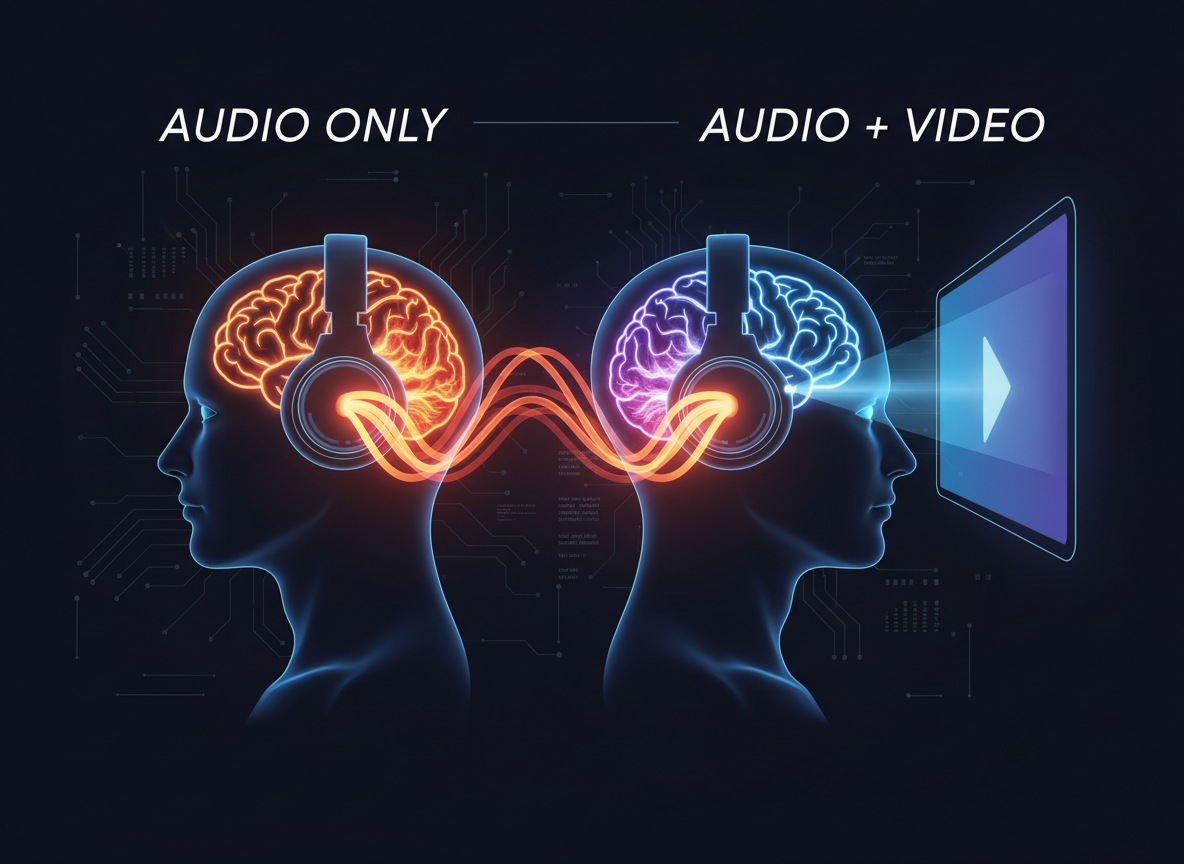
This is why audio and video cannot be treated as interchangeable layers. When people listen to a podcast in audio only, the brain welcomes the experience with warm attention. Sound goes directly to comprehension and immediately stimulates imagination. This is the theater of the mind, one of the most powerful aspects of audio storytelling. With no visuals provided, the listener creates their own. They develop characters, locations, emotions, and meaning from the sound alone. Their own memories and biases shape the story in a deeply personal way.
When I compare this with my early television work, the contrast is striking. In video, the audience does not imagine the scene. They watch the scene that has been crafted for them. Their eyes choose what to focus on first. Their interpretation is guided by the camera, the color, the setting, and the movement. This fundamental difference is the reason podcast production cannot simply lift an audio track and place it under random visuals. The brain interprets these forms of storytelling in different ways.
The Moment You Add Video, Everything Changes
Once video enters the frame of a podcast, the listener is no longer just a listener. They become a viewer. The brain flips its priorities instantly. Vision becomes the dominant sense. The eyes choose what to examine. The visuals become the primary story driver. The audio, no matter how beautifully crafted, becomes a supporting element. It accompanies the image.
This shift creates a challenge for creators who have built their podcasts through audio alone. A common instinct is to take an existing audio episode and place B roll or simple visual coverage over top. It seems efficient and cost effective. However, because the brain is wired to prioritize vision, the visuals have to be intentional. They need to be constructed to carry the narrative, not simply decorate it. If the visuals do not communicate the story clearly, the viewer feels an emotional gap. They sense confusion or distance even if they cannot articulate why.
This does not mean anyone is doing something wrong. It simply means that the narrative structure must change when podcasting enters video. What works in audio only is not always what works when the eyes are involved. Understanding this difference is the key to creating stronger, more compelling visual podcasts.
Why Success Comes From Adding Audio to Video
People often ask what the correct approach is when expanding from audio into video. The simplest explanation is this. Success comes from adding audio to the video, not the other way around. In other words, once visuals appear, they must be the foundation of the story. The audio should support and elevate what the viewer is seeing. This is the reverse of traditional podcast production, where sound is the foundation and everything else flows from it.
When we understand how the brain processes mixed media, we can design content that works in both environments. Podcasting can still maintain its rich, exploratory nature, while video can carry the structure and lead the viewer through the narrative. When these two elements work together intentionally, the result is far more engaging than either form on its own.
Creators who embrace this shift often discover that their audio storytelling becomes even stronger. They learn to refine pacing, emotion, and clarity to match their visual style. The theater of the mind does not disappear. It simply evolves. It becomes part of a more expansive storytelling toolkit that supports modern podcast production.
Where Podcasting Is Headed Next
It has been fascinating to watch creators reshape their shows for platforms like YouTube and Spotify. The rise of visual podcasting has opened new doors for discovery and audience growth. Viewers engage differently when they can see faces, environments, and expressions. Conversations feel more intimate. Ideas feel more grounded. Podcast production itself has become more cinematic.
What excites me most is seeing creators realize that this is not a technical transition. It is a storytelling transition. Once they understand how the brain receives audio and video, they can reshape their content in a way that respects both senses. The result is a podcast that thrives everywhere the audience listens and watches. It is a richer experience for the creator and a far more satisfying experience for the consumer.
Podcasting will always have audio at its heart. Video does not replace that. It expands it. And when creators approach this expansion with clarity and intention, their podcasts become more vibrant, more emotional, and more memorable than ever before.