
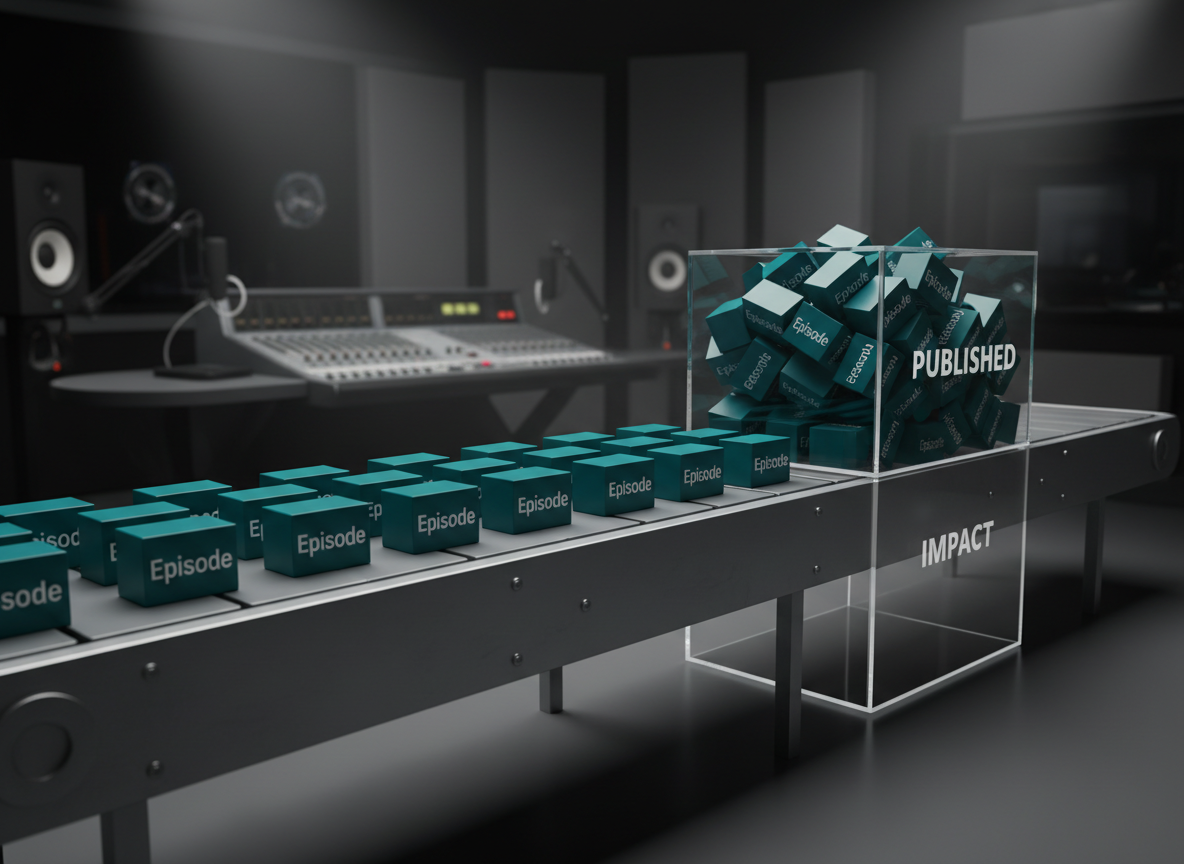
A podcast can sound expensive and still do nothing.
The audio is clean. The edits are tight. The video looks sharp.
The episodes keep shipping.
Then someone asks the question nobody wants to answer.
What changed because we published this?
That is the gap. Not between good and bad production.
Between a podcast as content and a podcast as a business tool.
If you want the basic overview of services, I already wrote that here.
This article is about the gap most teams miss and how to avoid paying for polish that never gets activated.
It is about the trap.
And how to avoid it.
The Trap: Production Is Not Strategy
Here is the uncomfortable truth.
A podcast can be polished and still be pointless.
Great audio is a baseline. Great video is a baseline. Great editing is a baseline.
What creates demand is activation.
If nobody shares the episode, the episode does not work.
Those things help. But they are not the job.
The job is impact.
Smart teams do not stop at downloads. They look for proof the show is getting used. In sales follow ups. In recruiting. In partner conversations.
That idea lands because it matches what many teams feel.
They keep asking:
Why are we doing this every week?
Why does this take so much time?
Why is it not changing anything?
Often the answer is not the host.
It is not the format.
It is not even the topic.
It is the model.
Many podcast production agencies sell production as the main event.
But production is only one part of the chain.
That is why you can hire a podcast editing agency and still get no results.
That is why you can hire a video podcast agency and still get no results.
That is why you can hire a podcast video editing agency and still get no results.
The output looks better. The outcome stays the same.
So here is the question that matters: what should podcast production agencies own besides the edit?
Two Types of Podcast Production Agencies
You can spot the difference in the first call.
The Production Vendor
A studio-first agency makes what you ask for.
You send the recording.
They clean it up.
They cut the mistakes.
They publish the episode.
Maybe they make clips. Maybe they write show notes.
That is valuable. It saves time.
But it does not solve the hard part.
Because you still own the strategy.
You still own the distribution plan.
You still own the growth engine.
You still own whether the show ever gets used inside the business.
In this model, you can end up with a podcast that is basically a hobby with invoices.
The Growth Partner
An outcome-first agency builds a system.
They do not start with “How long should the episode be?”
They start with “What should this show change?”
They connect the show to a real outcome.
That could be:
More qualified conversations
More partner interest
More recruiting pull
Shorter trust cycles
More inbound from a niche audience
This is outcome-first work. Most shows stall because nobody owns the bridge between the episode and the next action.
They also care about repeatability.
They build a workflow that makes the show easy to keep.
That is what most teams actually need.
Because the killer of podcasts is not bad audio.
It is inconsistency.
When a show dies, it is usually because it becomes too heavy to carry.
So when you evaluate podcast production agencies, you are not only buying craft.
You are buying a system that makes publishing feel light.
Think of it as two deliverables, every time.
The episode. And the activation kit.
 What Podcast Production Agencies Actually Do (When They Do It Right)
A strong podcast production agency does production. Yes.
But it also owns the work that makes production matter.
1) They define the job of the show
This is where the business gap gets closed.
A show needs a job that can be explained in one sentence.
Not “brand awareness.” That is fog.
A job sounds like:
This show turns target guests into warm relationships.
This show gives sales a trust asset they can send after calls.
This show makes hiring easier by showing culture and thinking.
This show positions us as the safe choice in a confusing market.
When the job is clear, everything else gets easier.
The format gets sharper.
The guest list gets smarter.
The topics stop being random.
2) They make decisions before you hit record
This is the part most people do not see.
Growth partners create templates.
They create:
A repeatable episode structure
A guest prep system
A question bank that fits the show’s job
A pre record checklist
A post record workflow
A clear review process so edits do not drag on forever
This is why some teams love a podcast agency and recording studio model. It removes friction.
But the studio is not the point.
The system is the point.
That is what separates a podcast studio agency from a room with microphones.
3) They produce the assets that travel
This is where a podcast becomes useful.
Not everyone will listen to a full episode.
But people will watch a sharp 45 second clip.
They will read a strong LinkedIn post.
They will save a quote graphic.
They will forward a short segment to a teammate.
This is where a podcast repurposing agency earns its keep.
The goal is not to chop the episode into random clips.
The goal is to package the ideas so they move across platforms.
And if video is part of your plan, you may want a podcast video agency that understands YouTube packaging, hooks, and thumbnails, not just timelines and cuts.
A Podcast video agency should think like a publisher, not just an editor.
4) They distribute on purpose
A lot of teams treat distribution like a prayer.
Post it. Hope it spreads.
Growth partners treat distribution like a plan.
They decide where the episode will show up.
They decide what the audience will see first.
They decide how guests will share it.
They decide what sales can use.
They decide what the company can reuse.
They build a share kit.
They write suggested copy.
They give the guest clean assets.
This is where many podcast production agencies fall short.
The episode is done, but nothing is set up to move it.
The business does not care that an episode shipped. The business cares whether the episode moved anything forward.
5) They track what matters
Downloads can be fine. They can show reach.
But they do not prove impact.
Metrics should be tied to revenue outcomes and attribution, not vanity charts.
You do not need a complex dashboard to start.
You need a few simple signals that match the show’s job.
Things like:
Replies from target listeners
Inbound messages that mention an episode
Sales using clips in follow ups
Guests turning into meetings
Partners sharing the show without being asked
A good podcast creation agency will ask about this early.
A vendor will ask about this never.
A Simple Test Before You Hire
If you want to avoid the “great audio, zero impact” trap, ask this question:
When the edit is finished, what happens next?
If the answer is “we upload it,” you are buying production.
If the answer is “we launch an asset set and a distribution plan,” you are buying a system.
That is the difference.
It is also why the label matters.
Podcast production agencies can mean anything.
One agency might be a podcast creator agency that helps you shape the concept, build a workflow, and connect the show to outcomes.
Another might be a podcast editing agency that delivers clean files and stops there.
Neither is evil.
But they are not the same product.
So name what you want.
If you want clean audio and time saved, hire for production.
If you want business impact, hire an agency that acts like a growth partner. That is what a real podcast production agency should be.
The Bottom Line
A podcast can be beautiful and still be useless.
That is the gap.
Agencies often focus on downloads and polish, while companies need outcomes and momentum.
So yes, podcast production agencies help you plan, record, edit, publish, and promote.
But the best podcast production agencies do more than that.
They make the show easier to sustain.
They make the content easier to reuse.
They make distribution a process.
They make the podcast matter inside the business.
If you are hiring, do not only ask “Can you make it sound good?”
Ask:
Can you make it work?